Posts

Showing posts with the label Symbolism

Death and the Gravedigger by Carlos Schwabe (Interpretation and Analysis)
Image
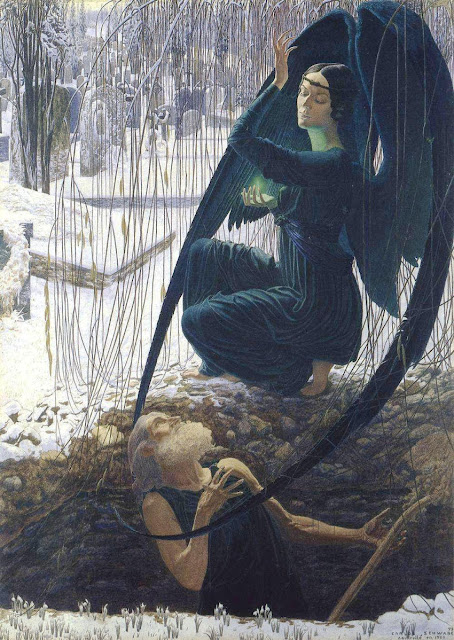
Death and the Gravedigger Source: Wikimedia Commons The work of Carlos Schwabe can be described in one word: bizarre. Schwabe created some of the weirdest and creepiest paintings in all of Western art, ranging from the bloody and the horrifying to Romantic and touching scenes. Regardless of subject, however, all of Schwabe’s work exhibits a fiercely original mind and an expansive imagination. Schwabe was associated with the Symbolist movement, which centered on the idea of seeking a higher truth through art. Unlike previous generations of artists who sought truth through realism, Symbolist artists used their own powers of imagination, dreams, and visions to explore the artist’s personal experience of reality. As such, Schwabe’s paintings are individualistic and experimental. He was particularly interested in exploring the idea of death, a subject he often tackled through the portrayal of women. Death and the Gravedigger is a good example of this aspect of his art. It is an allegorical ...

Fear by Odilon Redon (Interpretation and Analysis)

Image
Fear Source: Art Institute of Chicago French painter Odilon Redon was the leader of his own particular artistic revolution. His work was far ahead of its time, so much so that his art would inspire and inform the work of Surrealist painters and other modern art movements years after Redon’s death. Redon was aligned with the Symbolist movement, which centered on the idea of seeking a higher truth through art. Unlike previous generations of artists who sought truth through realism, Symbolist artists reacted against the increasing industrialization and standardization of the modern world. Instead, they used their own powers of imagination, dreams, and visions to explore the artist’s personal experience of reality. Redon’s paintings and drawings are wildly creative and inventive, utilizing a unique and easily recognizable visual style. His early work is particularly innovative; as a young artist, Redon created a series of noirs , drawings and lithographs executed in shades of black. These ...

The Smiling Spider by Odilon Redon (Interpretation and Analysis)

Image
Smiling Spider Source: Wikimedia Commons French painter Odilon Redon was a revolutionary artist. Or, perhaps it’s better to say that he was the leader of his own particular artistic revolution. His work was far ahead of its time, so much so that his art would inspire and inform the work of Surrealist painters and other modern art movements years after Redon’s death. So, what makes his work so revolutionary? Redon’s paintings and drawings are wildly creative and inventive, utilizing a unique and easily recognizable visual style. His early work is particularly innovative; as a young artist, Redon created a series of noirs , drawings and lithographs executed in shades of black. These pieces tend to be dark, bizarre, and melancholic with otherworldly or supernatural themes. The Smiling Spider is one of Redon’s most famous noirs . As the title suggests, the piece is a lithograph of a grinning spider with a humanoid face. Its ten legs are sprawled across the page, making it seem almost like...

Hercules and the Lernaean Hydra by Gustave Moreau

Image
Hercules and the Lernaean Hydra Source: Art Institute of Chicago For centuries, classical mythology has been a prime source of material for Western artists. Between the fifteenth and nineteenth centuries in particular, these stories seemed to have near universal appeal to painters. The labors of Hercules—a series of stories that detail twelve tasks undertaken by the hero Hercules in service of King Eurystheus—were an especially popular subject among European viewers. While paintings of Hercules abound, few artists had a more profound connection to the character than French painter Gustave Moreau. Moreau was one of the primary leaders of the Symbolist movement, and he was fascinated by the story of Hercules, a subject he returned to many times throughout his career. Moreau’s primary consideration as an artist was to convey truth through his work. In the case of Hercules, he achieved this by using the greatest hero of Greek mythology as a metaphor for the ancient, archetypal battle betwe...

Dejanira (Autumn) by Gustave Moreau (Interpretation and Analysis)

Image
Dejanira (Autumn) Source: J. Paul Getty Museum Today is the first day of fall! In honor of the new season, I wanted to share a painting with you that captures the autumnal spirit: Dejanira or Autumn by Gustave Moreau. Dejanira (Autumn) depicts a story from Greek mythology. According to legend, Dejanira was the wife of the great hero Hercules. One day, while attempting to cross a river, Dejanira was abducted by a wild centaur named Nessus. However, Hercules was able to rescue his wife by hiding among the rocks on the other side of the river and successfully ambushing and killing Nessus. This incident indirectly led to Hercules’ death. Moreau’s painting captures Nessus carrying Dejanira across the stream, the moment before the pivotal battle between the centaur and the hero. It can be seen as the calm before the storm, a liminal space on the edge of death and destruction. Moreau was one of the primary leaders of the Symbolist movement, which reacted against the increasing industriali...

Snow Falling in the Lane by Edvard Munch (Interpretation and Analysis)

Image
Snow Falling in the Lane Source: WikiArt We had quite a big snow storm in my neck of the woods today. I particularly dislike snow, as it forces me to shovel and makes the roads treacherous. However, in honor of the first big snow of the year, I want to show you a painting entitled Snow Falling in the Lane by the great Norwegian artist Edvard Munch. Munch is best known as the painter of The Scream , one of the most recognizable paintings in the world. His style is extremely distinctive, characterized by bright colors and bold lines. Munch used painting to explore his psychological and emotional reality, which inspired this distinctive style. Thus, every Munch painting is a reflection of his own personal worldview. Snow Falling in the Lane depicts a winter scene. As the title suggests, the painting depicts a man and a woman walking down a snowy lane. The two figures are only half-visible, caught in the moment of walking out of the frame. Behind them, the viewer can see the lane receding...

Les Licornes (The Unicorns) by Gustave Moreau (Interpretation and Analysis)

Image
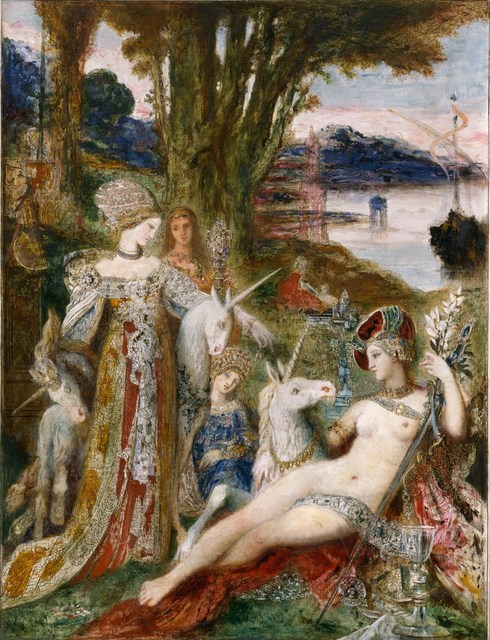
Les Licornes Source: Artsy Symbolism was a reaction against the increasing industrialization and standardization of the modern world. The Realist movement celebrated these aspects of modern life, and Realist painters devoted themselves to capturing the world in all its gritty disarray. The Symbolists, however, felt that artists should seek a higher truth in their work. French artist Gustave Moreau—one of the leaders of the Symbolist movement—sought to achieve this through mythological and religious subjects, portrayed in a fantastical style that drew inspiration from the art of the Italian Renaissance. While many of his paintings are wonderfully weird, dramatic, and elaborate (in the best possible sense), Les Licornes is a particularly lavish and fantastical piece. The painting depicts a group of richly dressed princesses surrounded by a herd of unicorns. According to my research , the painting depicts a magical island with an all-female population, inspired by Themyscira, the mytholo...

The Wounded Angel by Hugo Simberg (Interpretation and Analysis)

Image
In 2006, citizens of Finland voted The Wounded Angel their country’s national painting, and it’s not hard to see why. While the exact meaning of the painting is unclear, it is a profoundly moving piece, one that appeals to the viewers on a deep and personal level. The piece was created by Hugo Simberg, one of Finland’s most famous painters. He was a member of the symbolist movement, an artistic movement that sought to expressive higher truths through art. Simberg revels in strange and supernatural subjects, and his work typically has an otherworldly and melancholic aura. The Wounded Angel Source: Wikimedia Commons His Wounded Angel is certainly a melancholy piece. It depicts two young boys carrying an angel, in the form of a small girl, on a stretcher. The angel has a broken wing and a bandage wrapped around her head. The landscape behind the three figures is actually a real place, the Töölönlahti Bay near Helsinki. In fact, the path the angel traveled still exists and is open to the ...

Strange Garden by Józef Mehoffer (Interpretation and Analysis)

Image
Strange Garden Source: Wikimedia Commons I first encountered the painting Strange Garden while doing research on another piece of art, and I knew immediately that it would be the perfect painting to brighten up these short November days. The piece was created by Polish artist Józef Mehoffer, who was well known as a painter and a designer of items like textiles and stained glass. His work was inspired by the Symbolist and Post-Impressionist movements. Although he was relatively famous in the late nineteenth and early twentieth centuries, today he is virtually unknown outside of Poland. Strange Garden was painted between 1902 and 1903, when Mehoffer had already become a successful and well-known artist. The piece was created while Mehoffer was on vacation with his family and depicts members of the family standing in a lush garden. The focal point of the painting is a small, nude boy in the foreground. The boy holds bunches of flowers in each hand and seems to glow from within. The boy ...

Reflection by Odilon Redon (Interpretation and Analysis)

Image
Reflection Source: Wikimedia Commons As we drift towards winter, I thought I’d share a painting that reminds me of spring and summer. With its warm, vibrant colors and serene subject matter, it is certainly a piece for gentler weather. Reflection depicts a woman, dressed in a long, flowing garment, gazing down at her reflection in an indistinct body of water. The landscape blurs together here, detail lost in a haze of bluish-purplish water, rolling blue hills, and a pinkish sky. Simply put, it is a feast for the eyes, a cheerful and peaceful painting that inspires introspective calm. French artist Odilon Redon executed a number of these soothing, colorful paintings after recovering from a serious illness in 1895. During this period, he developed a dreamlike style that was heavily inspired by Japanese art and the natural world. Redon himself was a rather revolutionary artist. His paintings and drawings are wildly creative and inventive, utilizing a unique and easily recognizable visual...

The Garden of Death by Hugo Simberg (Interpretation and Analysis)

Image
The Garden of Death Source: Wikimedia Commons As I’ve written before, I’m focusing on spooky art this October, and what’s spookier than a skeleton? The answer is nothing except a whole garden of skeletons, and that is the subject of Hugo Simberg’s macabre masterpiece, The Garden of Death .  Simberg is one of Finland’s most famous painters. He was a member of the symbolist movement, an artistic movement that sought to expressive higher truths through art. Simberg revels in strange and supernatural subjects, and his work typically has an otherworldly aura. The Garden of Death portrays three skeletons dressed in the traditional black robe of the Grim Reaper. The reapers tend raised beds full of colorful flowers and exotic plants. While the subject of the painting may seem grisly, it is actually a rather optimistic portrayal of death. The contrast of the skeletons and the flowers is a reminder that the cycle of life and death is an endless loop that always returns to birth and renewal...

Lucifer by Franz von Stuck (Interpretation and Analysis)

Image
Lucifer Source: Wikimedia Commons There are few things more spooky than Satan, am I right? So, as October continues, I want to share one of the creepiest paintings of the devil out there: Lucifer by German artist Franz von Stuck. In a word, von Stuck’s work can be described as dark. Some of his most famous paintings include subjects like Dante’s Inferno, the Roman god of the Underworld, Pluto, original sin, seduction, and, of course, Lucifer himself. von Stuck was a member of the Symbolist movement, an artistic style that sought to convey meaning through the artist’s own particular language of symbolism. While their styles vary greatly Symbolist painters tend to lean on mythology, mysticism, and dream-like imagery. According to my research , von Stuck approached Symbolism through focus on the idea of duality and the nature of humanity. His art explores the contradictory nature of the human condition, such as life and death or pain and pleasure. His work was well-respected by other art...

Faun by Moonlight by Léon Spilliaert (Interpretation and Analysis)

Image
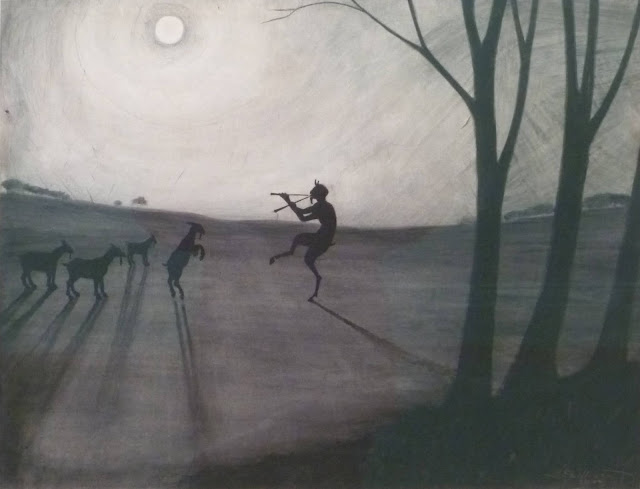
Faun by Moonlight Source: Wikimedia Commons If you want to create a spooky atmosphere in your home this fall, look no further than the work of Belgian artist Léon Spilliaert. Spilliaert’s art is characterized by dark color schemes, enigmatic subjects, desolate landscapes and lots of drama. Spilliaert’s uniquely gloomy style emerged from the Symbolist movement. The Symbolists felt that artists should seek a higher truth in their work. Like the Romantics before them, Symbolists turned toward an emotionally rich and psychologically complex visual lexicon. However, while the Romantics often accomplished this through painting the natural world, Symbolists pursued a more abstract approach. As the name suggests, Symbolist artists used a symbolic language to convey an internal world of thoughts and emotions. Spilliaert achieved this through a dark and dramatic form of introspection, which is on display in paintings like Faun by Moonlight . The piece depicts a faun playing pipes as he leads a h...

Posthumous Remorse by Carlos Schwabe (Interpretation and Analysis)

Image
Posthumous Remorse Source: Pinterest As the third day of Spooky Season (a.k.a. October) begins, I want to talk about the art of Carlos Schwabe, who created some of the weirdest and creepiest paintings in all of Western art. The work of Schwabe—who was part of the Symbolist movement—ranges from bloody and horrifying to Romantic and touching. Yet, all his work exhibits a fiercely original mind and an expansive imagination. Like all Symbolists, Schwabe was interested in seeking a higher truth through art. Like the Romantics before them, Symbolists turned toward an emotionally rich and psychologically complex visual lexicon. However, while the Romantics often accomplished this through painting the natural world, Symbolists pursued a more abstract approach. As the name suggests, these artists used a symbolic language to convey an internal world of thoughts and emotions. Although Schwabe is well known as a Symbolist, his painting Posthumous Remorse is not so complex when it comes to symbolis...

Destiny by Carlos Schwabe (Interpretation and Analysis)

Image
Destiny Source: Wikimedia Commons A few weeks ago, I stumbled upon the work of Swiss Symbolist painter Carlos Schwabe, and I’ve been grappling with its strangeness ever since. I often describe the work of certain artists as weird or unusual (always compliments in my estimation), but Schwabe’s work is downright bizarre. Just google his name and you’ll see what I mean. While his paintings range from bloody and horrifying to Romantic and touching, all his work exhibits a fiercely original mind and an expansive imagination. Like all Symbolists, Schwabe was interested in seeking a higher truth through art. Like the Romantics before them, Symbolists turned toward an emotionally rich and psychologically complex visual lexicon. However, while the Romantics often accomplished this through painting the natural world, Symbolists pursued a more abstract approach. As the name suggests, these artists used a symbolic language to convey an internal world of thoughts and emotions. Schwabe was pa...

The Absinthe Drinker by Léon Spilliaert (Interpretation and Analysis)

Image
The Absinthe Drinker Source: King Baudouin Foundation The nineteenth and twentieth centuries represented an artistic explosion in the Western world. As modernization and industrialization increased, dozens of artistic movements emerged in response to the rapidly changing social and economic conditions. Symbolism was one of these movements. In my opinion, Symbolism was a reaction against the increasing industrialization and standardization of the modern world. The Realist movement celebrated these aspects of modern life, and Realist painters devoted themselves to capturing the world in all it’s gritty disarray. The Symbolists, however, felt that artists should seek a higher truth in their work. Like the Romantics before them, Symbolists turned toward an emotionally rich and psychologically complex visual lexicon. However, while the Romantics often accomplished this through painting the natural world, Symbolists pursued a more abstract approach. As the name suggests, Symbolist artis...

Death and Life by Gustav Klimt (Interpretation and Analysis)

Image
Death and Life Source: Leopold Museum Following my discussion of El Velorio yesterday, I want to continue our conversation about the symbolic contrast between life and death in art. Death and Life by Gustav Klimt is perhaps the most starkly symbolic depiction of this dichotomy. Like almost all of Klimt’s work, the painting is firmly grounded in visual symbolism. Klimt was part of the symbolist movement. As the name suggests, the symbolists rejected naturalism and realism in paintings, instead choosing to explore the spiritual and philosophical world through the use of symbolic imagery. Their work aimed to access a higher truth, a level of spiritual and emotional reality that was neglected by the work of realist painters. According to my research , Klimt was inspired by the dance of death motif in Medieval art, which explores the idea that death comes to all people. His painting reexamines this theme for the modern age. On the left, stands the skeletal figures of death, gazing ...