Posts

Showing posts with the label Remedios Varo

My Favorite Paintings of the Year

Image
2020 is over! I’m sure we’re all rejoicing that this difficult year is over. However, despite all the problems that 2020 created, I also had a great time exploring art over the past year. I’ve discussed 365 pieces of art in the past 365 days, so, today, I want to recap the year by talking about some of my favorite paintings that I’ve covered in the past year. Without further ado, let’s dive in. Happy New Year! 1. El Velorio by Francisco Oller - I can clearly remember the first time I saw Francisco Oller’s masterpiece El Velorio . A print of the famous piece was hanging on the wall of a Puerto Rican funeral home that I visited after the death of a relative. My mother identified the painting in passing, telling me that it was very famous. I later researched the painting on my own, and it has been one of my favorites ever since. El Velorio is one of the most famous pieces of art in Puerto Rico. Measuring eight by thirteen feet, El Velorio (which literally translates to The Wake) is tru...

Allegory of Winter by Remedios Varo (Interpretation and Analysis)

Image
Allegory of Winter Source: WikiArt Today is the last day of the year. It’s been a wild and stressful ride, and I have to say that I’m glad to turn the page on this year. As we look forward to 2021, however, I want to share one more painting: Allegory of Winter by Remedios Varo. I am often captivated by Varo’s paintings. She was one of the most imaginative artists of her age, employing a complex set of symbols and visual story-telling techniques to convey meaning. As a result, her paintings often conjure images of some half-imagined, legendary past, steeped in magic. Varo’s profound creativity can be seen in paintings like Allegory of Winter. The painting portrays strange, spiky, cactus-like plants growing in a parched, barren landscape. White snowflakes swirl in the background against a flat, grey sky. Ice-like pods grow between these strange trees, crystallizing into multi-faceted shapes. Each of these ice crystals contains a different bird, flower, or insect, perhaps representing r...

Solar Music by Remedios Varo (Interpretation and Analysis)

Image
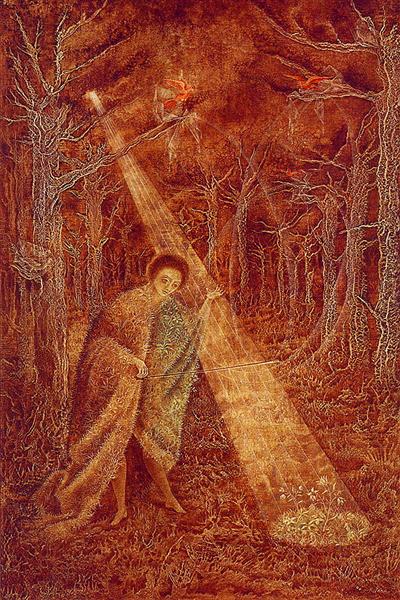
Solar Music Source: WikiArt I am often captivated by the paintings of Spanish-Mexican painter Remedios Varo. Varo was one of the most imaginative artists of her age, employing a complex set of symbols and visual story-telling techniques to convey meaning. As a result, her paintings often conjure images of some half-imagined, legendary past, steeped in magic. Varo’s profound creativity can be seen in paintings like Solar Music , a masterpiece that was created in 1955. The piece reflects Varo’s perennial interest in creation and creative acts. The piece depicts a forest, painted in shades of red and other earth tones. A woman—who strongly resembles Varo—stands in the center of the scene, dressed in a voluminous robe that seems to be made out of the forest floor itself. She draws a bow across a beam of light; this, presumably, is the solar music. In this artistic world, the combination of light and music (symbolized by the bow) creates a mystical force. A flower springs from the earth whe...

Exploring the Sources of the Orinoco River by Remedios Varo (Interpretation and Analysis)

Image
Exploring the Sources of the Orinoco River Source: WikiArt When you’re looking for a painting to spark your imagination, you can always count on Remedios Varo. Varo was one of the most creative and original artists of her age. Her paintings feature strange structures and otherworldly contraptions as well as a vast array of colorful and unusual characters. Though her art often portrayed fantastical scenes, Exploring the Sources of the Orinoco River has its origins in actual events. The piece depicts Varo in a strange, red boat sailing through an aquatic forest. Water spills from a crystal goblet that stands inside the trunk of a tree. The water feeds the river, the mystical source of the Orinoco River in Varo’s imaginings. Varo was part of a real expedition to the actual Orinoco River in Venezuela in 1947. This experience undoubtedly inspired Exploring the Sources of the Orinoco River , which was painted more than ten years after the original expedition. However, Varo’s artistic renderi...

Self-Portrait with Unicorn by Remedios Varo (Interpretation and Analysis)

Image
Self-Portrait with Unicorn Source: Pinterest The world of Surrealist art is wild and wonderful. The Surrealist movement represents a flourishing of imagination, taking viewers into the visionary world that lurks just out of reach of the conscious mind. Studying a Surrealist painting often involves a deep dive into the painter’s psyche, and this is especially true of self-portraits. There are few genres of painting more revealing or more interesting than the self-portrait. As the term suggests, self-portraits reveal the way the artist sees themselves, in a literal or symbolic sense. Spanish-Mexican artist Remedios Varo’s Self-Portrait with Unicorn is one of the most stunning and interesting examples of the self-portrait genre. Varo was one of the most creative and original artists of her age. Her paintings tend to be inhabited by a vast array of colorful and unusual characters that are unrecognizable as either humans or animals. However, her self-portrait makes use of a more convention...

Five Female Surrealists You Should Know

Image
When you hear the word Surrealism, you probably picture Salvador Dalí and his melting clocks or René Magritte and his pipe. However—although most of the most famous Surrealists were men—there is a rich history of female Surrealists that is often ignored by art education. Surrealist art seeks to bring the invisible things in life— thoughts, ideas, the human psyche— to the surface, expressing the spiritual and emotional worlds. So, today, I want to bring attention to some of my favorite female Surrealists and the weird and wonderful worlds they created through their painting. Bridget Bate Tichenor - Bridget Bate Tichenor came to art late in life. She spent most of her adult life as a model, fashion editor, and socialite in Paris and New York City. However, in the1950s she abandoned this life in order to seek spiritual fulfillment in Mexico, where she spent the rest of her life. While living there, Bate Tichenor began to create Surrealist paintings. She produced an oeuvre of fantastical ...

Star Catcher by Remedios Varo

Image
Star Catcher Source: WikiArt When you’re looking for a painting to spark your imagination, you can always count on Remedios Varo. Varo was one of the most creative and original artists of her age. Her paintings are inhabited by a vast array of colorful and unusual characters that are unrecognizable as either humans or animals. The titular character of Varo’s painting the Star Catcher is one such unusual creature. The piece depicts a humanoid figure dressed in bright and voluminous robes that are reminiscent of some sort of celestial body. A strange, helmet-like headdress completes her outfit. In one hand, she holds a cage containing a crescent moon while she holds a net in the other hand. It is clear that this creature is about to venture out into the sky in search of stars. Compositionally, the piece is very striking. While Varo’s paintings are usually complex and multilayered, Star Catcher is quite simple, featuring only one figure who looks directly at the viewer. This confron...

Insomnia by Remedios Varo

Image
Insomnia Source: Remedios-Varo.com It can be tempting to think that all art represents the feelings of the artist. The idea that art is the physical manifestation of thoughts and ideas that are unique to the artist is tantalizing; however, for many artists this is not the case. Commissions and patronage make up a large part of the art market. For example, in the 1940s Spanish-Mexican artist Remedios Varo—who was one of the leaders of the Surrealist movement—was hired by the drug company Bayer to produce an illustration that would help to sell their sleeping pills. The result was one of Varo’s early masterpieces: Insomnia . The piece depicts a matrix of dark rooms illuminated only by a single candle. Strange, glassy winged insects flap through the rooms as disembodied eyes look on. The flat, colorless style is not typical of Varo’s work, but it serves to illustrate the colorless misery of insomnia. The painting conjures a sense of uneasiness and distress that aligns well with the de...

The Troubadour by Remedios Varo

Image
The Troubadour Source: Sothebys I am often captivated by the paintings of Spanish-Mexican painter Remedios Varo. Varo was one of the most creative artists of her age, employing a complex set of symbols and visual story-telling techniques to convey meaning. As a result, her paintings often conjure images of some half-imagined, legendary past, steeped in magic. The Troubadour is one of her most beautiful and magical paintings. The piece depicts a man in a small boat with a female masthead sailing down a river through an enchanted forest. A woman who appears to be some sort of wood nymph plays a pipe on the banks of the river, while birds look on. Compositionally and stylistically, the piece owes much to European medieval art, making reference to traditional depictions of troubadours and manuscript illumination styles. This choice was not accidental. The piece was inspired by an expedition down the Orinoco River in Venezuela, which Varo participated in. This trip was hugely influentia...

Astro Errante (The Wandering Star) by Remedios Varo

Image
Astro Errante Source: Sothebys Spanish-Mexican artist Remedios Varo was one the most creative artists of her age. After fleeing Europe during World War II, Varo became one of the leaders of the famed Mexican Surrealist movement. Varo’s work is highly original and inventive, and used her painting to explore the boundary between the real and the fantastical. Astro Errante (which translates to The Wandering Star ) is an excellent example of her whimsical and playful style. The piece depicts an orange figure with a sun-shaped head. The figure is shrouded in a grey cloak as he walks across a dark sky. It is a beautiful and charming painting on its own merit, and the theme is so universal that the piece can stand on its own without much explanation. However, there are some obvious allusions here. The wandering star in this painting is scientifically accurate. Rather than a traditional, five-pointed star, Varo has chosen to depict the star as a burning ball of gas like our sun. Here, we ...

The Creation of The Birds by Remedios Varo (Interpretation and Analysis)

Image
The Creation of Birds Source: eugenefischer.com The work of Spanish-Mexican Surrealist painter Remedios Varo is sometimes playful and sometimes moving, but it is always wildly creative and fantastically original. Varo is one of my favorite artists to write about because her work is so strange (strange in the most delightful way, I might add). After fleeing Europe during World War II, Varo became one of the leaders of the famed Mexican Surrealist movement. Although Mexican influences are not obvious in her art, she captured the elements of fantasticism that are so common in Mexican art. She used her painting to bring this fantastical world to light and to explore the emotional and psychological responses it occasions. Varo was influenced by religious mysticism and magic, and it is clear that she tried to infuse spiritual meaning into her paintings.  The Creation of Birds (Detail) Source: Pinterest The Creation of The Birds demonstrates this quality within her work. T...

Cosmic Energy by Remedios Varo (Interpretation and Analysis)

Image
Cosmic Energy Source: WikiArt Spanish-Mexican artist Remedios Varo was one the most creative artists of her age. After fleeing Europe during World War II, Varo became one of the leaders of the famed Mexican Surrealist movement. Although Mexican influences are not obvious in her art, Varo’s work is highly original and inventive; Varo used her painting to explore the boundary between the real and the fantastical. Her work was largely inspired by religion and spiritual experience. Although Varo wasn’t necessarily religious, her paintings were highly influenced by religious mysticism, magic, and the energy that exists between living things in the world. This aim is clearly displayed in Cosmic Energy . The piece depicts a room in which strange, humanoid figures emerge from the wall. One figure plays a violin (at least, I think it’s a violin; it’s some sort of stringed instrument for sure), while the other figure strokes a cat. Beams of light pour through cracks in the wall, making flowe...

Vampiros Vegetarianos by Remedios Varo (Interpretation and Analysis)

Image
Vampiros Vegetarianos Source: Christies One of the most enjoyable things about Surrealist art is its charm. The work of modernists artists is often highly original and inventive, freed from the constraints of the patronage system that forced successful artists to take commissions from wealthy elites. Spanish-Mexican artist Remedios Varo was one the most creative artists of her age, and was one of the leaders of the famed Mexican Surrealist movement. While Mexican born artists developed a unique style incorporating elements of magical realism at the beginning of the twentieth century, that style was augmented when a stream of European Surrealist artists arrived in Mexico as they fled World War II. Varo was one such artist. After leaving Europe in 1941, she spent the rest of her life living and working in Mexico. Throughout her artistic career, she produced a tremendous volume of strange and unusual paintings, populated by a multitude of fantastical characters and creatures. However,...

The Fern Cat by Remedios Varo (Interpretation and Analysis)

Image
The Fern Cat Source: WikiArt Spanish-Mexican artist Remedios Varo was one of the leaders of the famed Mexican Surrealist movement. While Mexican born artists developed a unique style incorporating elements of magical realism at the beginning of the twentieth century, that style was augmented when a stream of European Surrealist artists arrived in Mexico as they fled World War II. Varo was one such artist. After leaving Europe in 1941, she spent the rest of her life living and working in Mexico. Throughout her artistic career, she produced a tremendous volume of highly original paintings, populated by a multitude of fantastical characters and creatures. El Gato Helecho (which translates to The Fern Cat ) is a fantastic example of her otherworldly scenes. Varo loved cats, and they appear in many of her paintings. According to my research , she was inspired to paint The Fern Cat after a friend told her about a dream she had about cats with ferns growing out of them. Varo transforms ...

Simpatía (La Rabia del Gato) by Remedios Varo (Interpretation and Analysis)

Image
Simpatía (La Rabia del Gato) Source: Christie’s Art including cats is my favorite kind of art, so today I want to show you an extraordinary painting entitled Simpatía ( La Rabia del Gato ), which translates to The Madness of the Cat . The painting is one of the great masterpieces of Remedios Varo, a Spanish-Mexican artist who was one of the leaders of the Mexican Surrealist movement. Varo is well-known for her strange, otherworldly paintings, populated by a world of mysterious figures engaged in bizarre, ritualistic acts. La Rabia del Gato is a fine example of her style. The piece depicts an orange figure with flamelike hair in a grey robe; the figure caresses an orange cat, who seems to levitate above the table. The cat has seemingly knocked over a glass of water, which has turned into a tiny ocean on the floor. A network of sparkling, golden dots glimmers above them, connected by shining filaments. This constellation-like design represents the loving energy that passes betwe...