Posts

Showing posts with the label Edvard Munch

The Dead Mother by Edvard Munch (Interpretation and Analysis)
Image
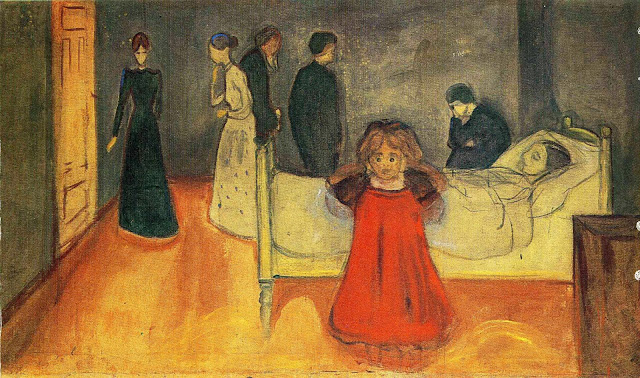
The Dead Mother Source: Wikimedia Commons Edvard Munch epitomizes the stereotype of the tortured artist. The Norwegian painter lived a difficult life that was marred by grief, family troubles, and substance abuse as well as physical and mental health issues. No piece of art better exemplifies this than Munch’s The Dead Mother . The painting depicts a deathbed scene. In the background, a dead woman with ghostly white skin lies on a bed while adults in dark clothes—presumably mourners or family members—cluster around her. However, the child in the foreground is the most memorable part of the piece. This little girl stands with her hands over her ears and an expression of abject horror on her face. It is clear that the child is in a state of profound shock and grief. The Dead Mother expresses total devastation, verging on madness.Although there are living adults in the room, the child is alone in her pain, standing isolated in the foreground. It is a very sad image, capturing a lonely l...
Self Portrait in Hell by Edvard Munch (Interpretation and Analysis)

Image
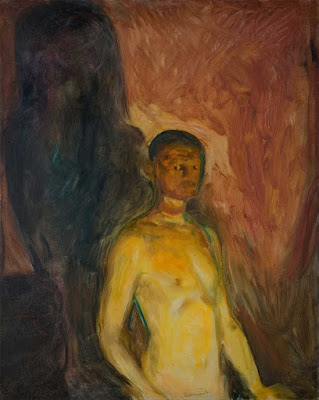
Self Portrait in Hell Source: Google Arts & Culture Edvard Munch’s painting The Scream is perhaps the most famous depiction of psychological pain and human suffering in all of art history. However, this theme is not unique in Munch’s work. In fact, there are few artists who are more known for portraying torment than Edvard Munch. Many of his paintings include figures at the extremes of human emotion, passing through a gauntlet of spiritual or emotional assault. This tendency in his work is perhaps a reflection of Munch’s own struggles. As a young child, Munch lost both his mother and his favorite sister to tuberculosis, and much of his childhood was overshadowed by grief. Their deaths also caused a lingering sense of sadness and unhappiness in the Munch household that left its mark on young Edvard. Munch also suffered from his own health problems as a child. As an adult, Munch also came to fear that he had inherited madness from his father. Speaking of his own childhood, Munch once...

Some Paintings to Celebrate Christmas

Image
Merry Christmas and Happy Holidays to all who celebrate! In honor of the holiday, I’ve decided to put together a collection of Christmas paintings to celebrate. Christmas Eve, 1887 by John Everett Millais - I think that most of us can imagine a Christmas scene. For obvious reasons, the holiday tends to be associated with Christmas trees, bells, and holly sprigs. Pre-Raphaelite artist John Everett Millais, however, took a different approach to the subject. The painting depicts a rural landscape, featuring crows and barren trees. Tiny footprints track through the snow and a brick manor house stands in the background. While it is a seemingly mundane scene, it is powerful and meaningful in its simplicity.  Christmas Eve, 1887 Source: Wikimedia Commons Christmas in the Brothel by Edvard Munch - Edvard Munch is well known as an eccentric, original painter. Munch is best known as the painter of The Scream , one of the most recognizable paintings in the world. His style is extremely dis...

Snow Falling in the Lane by Edvard Munch (Interpretation and Analysis)

Image
Snow Falling in the Lane Source: WikiArt We had quite a big snow storm in my neck of the woods today. I particularly dislike snow, as it forces me to shovel and makes the roads treacherous. However, in honor of the first big snow of the year, I want to show you a painting entitled Snow Falling in the Lane by the great Norwegian artist Edvard Munch. Munch is best known as the painter of The Scream , one of the most recognizable paintings in the world. His style is extremely distinctive, characterized by bright colors and bold lines. Munch used painting to explore his psychological and emotional reality, which inspired this distinctive style. Thus, every Munch painting is a reflection of his own personal worldview. Snow Falling in the Lane depicts a winter scene. As the title suggests, the painting depicts a man and a woman walking down a snowy lane. The two figures are only half-visible, caught in the moment of walking out of the frame. Behind them, the viewer can see the lane receding...

Saint Anthony the Abbot in the Wilderness by Osservanza Master (Interpretation and Analysis)

Image
Saint Anthony the Abbot in the Wilderness Source: The MET Museum I stumbled upon this painting while I was browsing the MET’s collection the other day (which is one of my favorite pastimes, by the way), and I was immediately struck by it. The painting, entitled Saint Anthony the Abbot in the Wilderness , depicts “the life of the hermit Saint Anthony Abbot,” according to the MET Museum. Although it dates to the late Medieval/ early Renaissance period, the painting feels very modern. In its vibrant color scheme and psychological reality, Saint Anthony the Abbot in the Wilderness reminds me of Edvard Munch’s famous painting The Scream . As the title suggests, the painting depicts the saint wandering in a desert, enduring temptation from the devil. Taken together, the scene represents the saint’s inner life, his struggles and his spiritual journey. It is an inward looking painting, underlaid by the saint’s self reflection. The composition of the painting reflects this dynamic. The...

Love and Pain by Edvard Munch (Interpretation and Analysis)

Image
Love and Pain Source: Google Art Project I don’t know much about the Norwegian artist Edvard Munch— painter of the famous painting The Scream— however, when I encountered this painting, Love and Pain , I was immediately struck by it. I stumbled upon Love and Pain while doing research on another piece of art. It’s a simple, but beautiful painting. The piece depicts a red haired woman kissing the neck of a pale man dressed in black. Many people view the painting in a sinister light; in fact, it’s sometimes called Vampire . The dark background and the woman’s interest in the man’s neck contribute to this interpretation. However, the artist himself stated that this interpretation was incorrect. Munch maintained that Love and Pain was simply a painting of a man and woman embracing. Although it is an ambiguous painting overall, I have a very simple interpretation. The painting is entitled Love and Pain . I believe the red haired woman represents love, and the dark haired man represents...