Posts

Showing posts with the label Edward Burne-Jones

Green Summer by Edward Burne-Jones (Interpretation and Analysis)

Image
Green Summer Source: Wikimedia Commons Happy summer! In honor of the first day of the season, I want to share a painting by the great Pre-Raphaelite artist Edward Burne-Jones. Burne-Jones stands out as one of the most productive and talented artists of his age; like many Pre-Raphaelites, he was driven by a desire to create serious and meaningful art. However, by the time Burne-Jones painted Green Summer in 1868, his art was beginning to move toward the values of the Aestheticism movement. Aestheticism in art is often defined as “art for art’s sake;” painters who embrace Aestheticism tend to prioritize the beauty of the piece and its aesthetic value over the meaning or moral significance of the painting. In many ways, the values of Aestheticism and Pre-Raphaelitism are completely opposite.  However, Burne-Jones continued to embrace the Pre-Raphaelite aesthetic in his work throughout his career. Famously, Burne-Jones’ paintings were heavily inspired by medieval artwork. This can be ...

The Star of Bethlehem by Sir Edward Burne-Jones (Interpretation and Analysis)

Image
Star of Bethlehem Source: Wikimedia Commons Among the painters of the Pre-Raphaelite movement, Edward Burne-Jones stands out as one of the most productive and talented artists of his age. Burne-Jones—like many Pre-Raphaelites—was inspired by the legends and myths of older cultures; however, he also created many pieces of religious artwork. As Christmas approaches, I’d like to share an example of this art. Burne-Jones’ Star of Bethlehem depicts the birth of Christ with the three Wise Men in attendance. This is a traditional and well-worn motif in Christian art that celebrates the Epiphany, the day on which the three Wise Men reached the Christ child after their journey. Though there are many versions of the Epiphany scene in Western art, Burne-Jones’ Star of Bethlehem is particularly beautiful. Burne-Jones first approached the subject of the Epiphany when he was commissioned to create a tapestry for the University of Oxford. He completed a version of the Star of Bethlehem — known as ...

The Nativity by Edward Burne-Jones (Interpretation and Analysis)

Image
The Nativity Source: Wikimedia Commons Among the painters of the Pre-Raphaelite movement, Edward Burne-Jones stands out as one of the most productive and talented artists of his age. Burne-Jones—like many Pre-Raphaelites— was inspired by the legends and myths of older cultures; however, he also created many pieces of religious artwork. As Christmas approaches, I’d like to share an example of this art. Burne-Jones’ Nativity depicts the birth of Christ, a traditional and well-worn motif in Christian art. Though virtually every major Western artist has painted the Nativity scene at some point or another, each painter has a unique interpretation, and Burne-Jones’ Nativity is particularly beautiful. It portrays the Virgin Mary resting with the newborn Christ Child while Joseph kneels by her bedside. Three angels stand to the left, looking on. The style and composition of the piece borrows heavily from Medieval art. While the scene is not dynamic, and, in fact, is rather stiff, the figures...

The Legend of Briar Rose by Edward Burne-Jones (Interpretation and Analysis)

Image
The Rose Bower Source: Wikimedia Commons Among all the Pre-Raphaelite artists, the work of Edward Burne-Jones seems to have lingered longest and most successfully in society’s collective imagination. Like all Pre-Raphaelite artists, Burne-Jones was inspired by a desire to create serious and realistic art that was also pleasing to the eye. Pre-Raphaelite painters were not interested in “trivial” scenes of everyday life. Instead, they believed art should portray “serious” subjects, such as literature, poetry, mythology, and history. The Briar Wood Source: Wikimedia Commons In particular, Burne-Jones drew inspiration from medieval art and topics, as can be seen in his series of paintings entitled The Legend of Briar Rose. The series, which includes four paintings, tells the story of Sleeping Beauty as related by the Brothers Grimm in their 1812 collection of European folktales; although, the legend of Sleeping Beauty actually dates back to at least the sixteenth century. The ...

The Beguiling of Merlin by Edward Burne-Jones (Interpretation and Analysis)

Image
The Beguiling of Merlin Source: Wikimedia Commons In my opinion, the art of the pre-Raphaelite movement is among the most objectively beautiful to ever be produced. The pre-Raphaelite movement was inspired by a desire to create serious and realistic art that was also pleasing to the eye. Pre-Raphaelite painters were not interested in “trivial” scenes of everyday life. Instead, they believed art should portray “serious” subjects, such as literature, poetry, mythology, and history. In particular, they drew inspiration from medieval art and topics, as can be seen in The Beguiling of Merlin , one of Edward Burne-Jones’ great masterpieces. According to my research, the piece depicts a scene from the Arthurian legend in which Merlin has been seduced by the famed Lady of the Lake, Nimue. According to the stories, Nimue withheld her love from Merlin until he taught her the secrets of his magic. Once she had learned all she could, she trapped him in the trunk of a hawthorn tree. Burne-Jones...

The Death of Medusa II by Edward Burne-Jones (Interpretation and Analysis)

Image
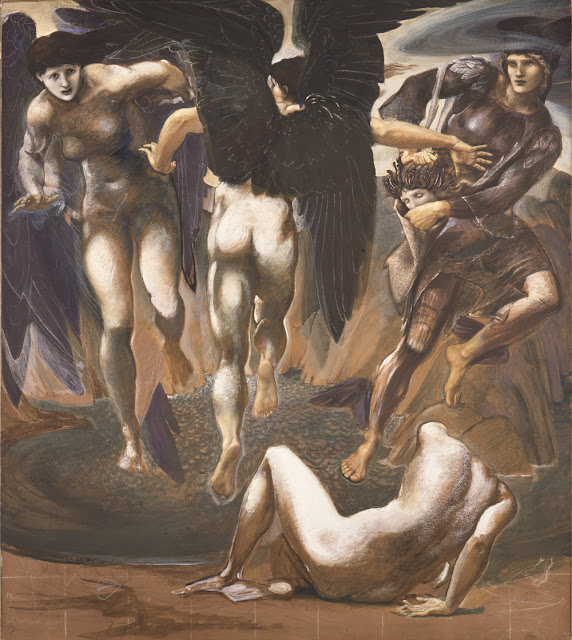
The Death of Medusa II Source: Southampton City Art Gallery Among the painters of the Pre-Raphaelite movement, Edward Burne-Jones stands out as one of the most productive and talented artists of his age. Like many of the Pre-Raphaelites, much of his work was inspired by the legends and myths of older cultures, spanning from the stories of Medieval Europe to the famed Greek myths. One subject that seemed to fascinate him was the story of Perseus. The legend of Perseus comes from Greek mythology. It tells the story of the heroic son of Zeus, Perseus, who embarks on a mission to save the princess Andromeda from the monstrous Gorgon, Medusa. Burne-Jones planned to tell the entire story through paintings, but he died before he could complete the project. The Death of Medusa II is one unfinished piece from the series. It depicts Perseus escaping with the head of Medusa while her sisters, the other two Gorgons, gaze at her dead body in distress. The Pre-Raphaelites strove for a degree of...

The Last Sleep of Arthur in Avalon by Edward Burne-Jones (Interpretation and Analysis)

Image
The Last Sleep of Arthur in Avalon Source: Museo de Arte de Ponce Today, I want to continue discussing the Pre-Raphaelite movement with The Last Sleep of Arthur in Avalon by Edward Burne-Jones. Although Pre-Raphaelite art is not something I know much about, it is a style that I find very attractive on an aesthetic level. As I said yesterday, if you want to know more about the style, I suggest you read this excellent essay ; however, the movement can generally be described as a paradoxical embrace of realism and a rejection of genre painting, the practice of depicting scenes of everyday life in paintings. Instead, Pre-Raphaelite artists believed art should portray “serious” subjects, such as literature, poetry, mythology, and history. In particular, they drew inspiration from medieval art, as is evidenced by The Last Sleep of Arthur in Avalon . As the title suggests, the painting depicts the mythical King Arthur in the midst of his final sleep; according to legend, Arthur was bro...