Hobgoblins (Duendecitos) by Francisco Goya (Interpretation and Analysis)
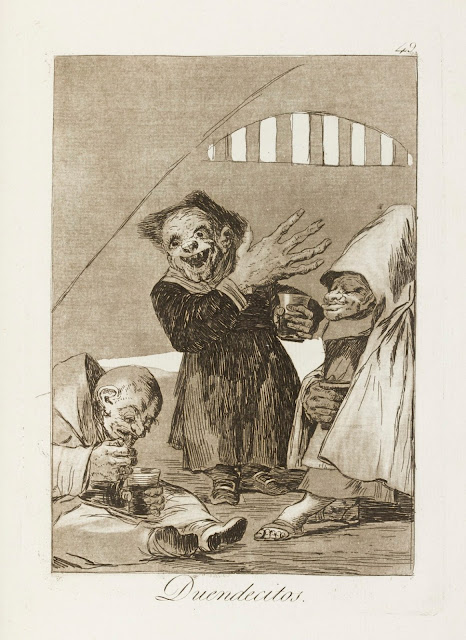
Duendecitos Source: Royal Academy of Arts Today, Francisco Goya is known as one of the most creative and forward-looking artists of the late eighteenth and early nineteenth centuries. This was a turbulent time in Europe, marked by war, revolution, and intellectual and political upheaval. This chaos provided ample artistic subjects for Goya, and current events and social attitudes became frequent themes in his work. Hobgoblins ( Duendecitos in Spanish) comes from Goya’s Caprichos , a series of prints created around the turn of the century. These prints present a satirical image of Spanish society, criticizing the follies, superstitions, and ignorance of people from every walk of life. The creation of the Caprichos marks a major turning point in Goya’s artistic life. Throughout his early career, Goya worked as a court artist, focusing mostly on formal portraits and tapestry cartoons intended to decorate royal residences. Since this work was created for patrons, it was fairly conventio...