Posts

Showing posts with the label Romanticism

The Sleepwalking Lady Macbeth by Henry Fuseli (Interpretation and Analysis)

Image
The Sleepwalking Lady Macbeth Source: Grand Palais (musée du Louvre) I love drama in art. That’s why I find myself drawn time and time again to the art of Henry Fuseli. His work is extreme and theatrical, capturing moments of horror, pain, and intense human emotion on the canvas. Although his work encompassed a variety of topics, his most memorable pieces touch on the liminal space between ordinary life and the world of supernatural horrors. Simply put, Fuseli’s art revels in the weird and dramatic. The Sleepwalking Lady Macbeth is a particularly spooky (perfect for Halloween) example of Fuseli’s dark and dramatic art. The painting depicts a key moment from Shakespeare’s play Macbeth. Here, we see Lady Macbeth—having previously killed the king—bemoaning her guilt as she sleepwalks through the castle. While asleep, she tries obsessively to wash her hands convinced that they are stained by blood. A doctor and attendent in the background look on in surprise, puzzled by her strange behavi...
Thor Battering the Midgard Serpent by Henry Fuseli (Interpretation and Analysis)

Image
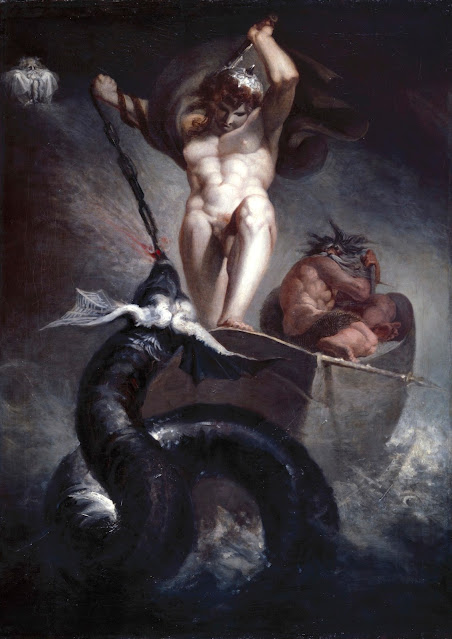
Thor Battling the Midgard Serpent Source: Wikimedia Commons Throughout history, many artists have set out to create shocking or dramatic scenes. However, few of them achieve this goal as successfully as Swiss artist Henry Fuseli. In fact, drama is the bread and butter of Fuseli’s oeuvre. His work is extreme and theatrical, capturing moments of horror, pain, and intense human emotion on his canvas. His work is most closely aligned with the Romantic movement, which drew its inspiration from emotion and individualism. Thus, it’s unsurprising that his work is steeped in melodrama (which is one of my favorite things in art). Thor Battering the Midgard Serpent is one of Fuseli’s most memorable paintings. Created as his diploma piece for entrance to the Royal Academy, the piece depicts a story from Norse mythology. Here, we see the Norse god Thor doing battle with the monstrous serpent Jörmungandr. According to legend, Jörmungandr—one of Loki’s children—encircled the whole world. In one tale...

The Changeling by Henry Fuseli (Interpretation and Analysis)

Image
The Changeling Source: Art Institute of Chicago  Swiss artist Henry Fuseli can best be described as a painter of horror. Although his work encompassed a variety of topics, his most memorable pieces touch on the liminal space between ordinary life and the world of supernatural horrors. Fuseli’s art revels in the weird and dramatic, and The Changeling certainly fits that description. The drawing depicts a common piece of European folklore: the changeling. According to legend, a changeling is a fairy child who is left in place of a human infant. The Changeling depicts one such moment of exchange. Here, we can see two women kneeling over a crib containing a fairy child. Their faces betray their horror as they realize that their charge has been abducted. In the background, a fairy can be seen flying out the window with the human child in tow. The entirety of this simple story is rendered in monochrome gray wash and graphite. It is direct and to the point, but powerful. In my opinion, ...

Tamara and the Demon by Konstantin Makovsky (Interpretation and Analysis)

Image
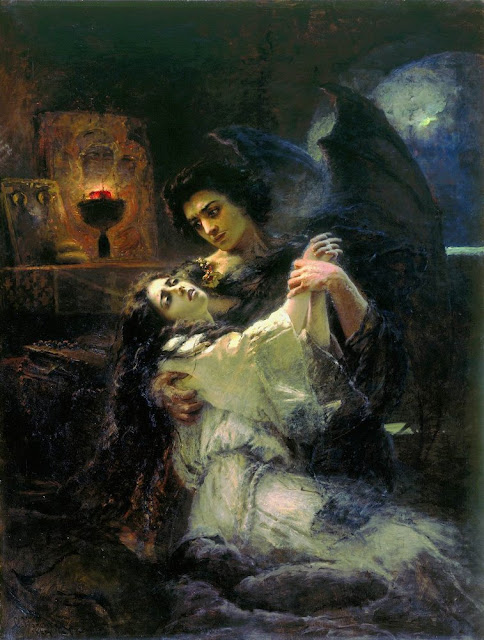
Tamara and the Demon Source: Wikimedia Commons Would you like to hear a spooky story? It is the Halloween season after all. Well the story I’m going to tell you today is about what happens when a princess meets a demon. Between 1829 and 1839, Russian poet and writer Mikhail Lermontov composed a narrative poem called The Demon . The protagonist of the piece is a Demon who wanders the Caucasus Mountains, wracked by miserable loneliness and hopelessness. Although the Demon is immortal, he views his long life as a perpetual and protracted torment until he happens to see a beautiful young princess named Tamara dancing at her wedding. The demon is immediately enthralled by her and decides to arrange the death of her husband so that he can take his place. Tamara is eventually won over by the Demon when she decides that he is neither an angel or a demon, but simply a tortured soul. The couple share a kiss, but the Demon’s lips are poison, and Tamara dies instantly. The poem ends with the Demon...

Orestes Pursued by the Furies by William-Adolphe Bouguereau

Image
Orestes Pursued by the Furies Source: Wikimedia Commons Some of the most gruesome and frightening stories in Western literature come from ancient Greek literature. As Halloween season continues, I want to bring you a painting that represents one of the darkest stories in Greek canon: the tale of Orestes. In Greek mythology and literature, Orestes is the son of the legendary King Agamemnon (of The Iliad ) and Queen Clytemnestra. As the story is told by the Greek tragedian Aeschylus, Clytemnestra swore vengeance against Agamemnon for sacrificing their daughter Iphigenia. When Agamemnon returned home after the end of the Trojan war, Clytemnestra and her lover murder Agamemnon and seize control of his kingdom. Years later, Orestes returns home bent on seeking revenge for his father’s death. Spurred on by the god Apollo, Orestes and his sister Electra conspire to kill their mother, and Orestes eventually succeeds in killing Clytemnestra and her lover. However, the murder of a family members...

Birth of the Human Soul by Philipp Otto Runge (Interpretation and Analysis)

Image
Birth of a Human Soul Source: Arthur There’s something about the world of art that seems to attract off-the-wall people. Maybe it’s the creative atmosphere. Maybe it’s the bohemian lifestyle. Maybe it’s the paint fumes. Who knows. What I do know is that Philipp Otto Runge was what I would call an off-the-wall individual. Runge was one of the greatest artists of the Romantic movement. He was a renowned painter of portraits who was known for his intense style. Not only did Runge write a truly gruesome story for the brothers Grimm and develop the idea of the color sphere—a crucial development in the study of color—he was also a religious mystic. Runge was a devout Christian who claimed a mystical understanding of God’s mysteries. His spirituality is clear and present in much of his art. He believed that symbolism and science went hand in hand, and he sought harmony between the spiritual and the natural world through his work. These aspects of his work can be seen in Birth of the Human Sou...

The Premature Burial by Antoine Joseph Wiertz (Interpretation and Analysis)

Image
The Premature Burial Source: Wikimedia Commons As a painter, Antoine Joseph Wiertz is relatively obscure, yet his work is incredibly devise and controversial. Wiertz—who is probably best defined as a Romantic painter, although that word doesn't really describe his art—had a penchant for creating grotesque and horrifying scenes. He seemed to be irresistibly drawn to the darker side of life, tackling gruesome subjects like suicide, cannibalism, and public executions. Some critics find his work to be needlessly graphic, a gratuitous attempt to attract attention through gore and shock value. For example, one critic described the Wiertz museum of Brussels in the following words : "In recent years the Wiertz Museum has attracted an average of just ten visitors a day ... The Belgian state is legally stuck with all 220 of his [Wiertz'] works—dreadful though most of them are—and an obligation to display them forever. ... [Wiertz was] perhaps the worst painter to have a government-f...

The Ghost of a Flea by William Blake (Interpretation and Analysis)

Image
The Ghost of a Flea Source: Wikimedia Commons Most people know William Blake as a poet. He’s particularly famous for his “Tyger Tyger, burning bright” poem, which I particularly enjoy. However, what most people do not know is that Blake was also a prolific artist with a distinctive and unique style. Blake’s illustrations for Dante’s Divine Comedy are perhaps his best-known works of art; however his painting The Ghost of a Flea is probably one of his most bizarre and unique works. The painting is part of a series of sketches that Blake created for astrologist and spiritualist John Varley. Blake had visions throughout his life, which fascinated Varley. Thus, he asked Blake to create a series of images based on his visionary experiences. The flea was one such apparition. Traditionally (and for good reason) fleas are associated with dirtiness, greed, and other undesirable attributes. According to my research , when the flea appeared to Blake, he understood it to be "...inhabited by ...

Self Portrait with Death Playing the Fiddle by Arnold Böcklin (Interpretation and Analysis)

Image
Self Portrait with Death Playing the Fiddle Source: Wikimedia Commons “Ars longa, vita brevis.” This famous quote—which is attributed to the Greek physician Hippocrates—translates to “art is long, life is short,” and it is the perfect phrase to describe the self-portrait of Swiss artist Arnold Böcklin. The piece depicts the artist hard at work with a palette full of paint. He gazes out into the distance, as if deep in thought about the painting he’s working on. Behind him, a grinning skeleton leans over his shoulder. The skeleton plays a fiddle with only one string, which, according to my research , is tuned to G. Böcklin seems to listen to this strange music as he paints, although he does not look toward the skeleton. The piece itself is rather informal and dramatic, showing the influence of Romanticism on Böcklin’s work. The iconography of this piece is a reference to two different artistic motifs that were common in European art: the memento mori and the danse macabre (the dance of...

The Nightmare by Henry Fuseli (Interpretation and Analysis)

Image
The Nightmare Source: Wikimedia Commons As spooky season continues, I want to share with you a painting that both fascinated and horrified eighteenth and nineteenth century viewers: Henry Fuseli’s masterpiece The Nightmare . Although much of his work tends to be moralizing, Fuseli was a painter who reveled in the weird and dramatic. Fuseli was often inspired by plays and other literature, giving many of his paintings a theatrical air. His work tended to be dark and color and peopled with dramatic figures in moments of physical or psychological crisis. The Nightmare , his most famous painting, is no exception. Although, it is unique in that it doesn’t present a clear message or moral. The piece portrays a woman in a white nightgown sprawled asleep on a bed. A squat, grimacing demon sits on her chest, while, behind the bed, a black horse pushes its head into the scene. Traditionally, the scene is interpreted as a literal depiction of the young woman’s nightmare, with the demon representi...

Orphan Girl at the Cemetery by Eugène Delacroix (Interpretation and Analysis)

Image
Orphan Girl at the Cemetery Source: Wikimedia Commons There’s a high likelihood that you’ve never heard the name Eugène Delacroix, but I can assure you that you’ve seen his work before. His famed Liberty Leading the People is now seen as the seminal image of the French revolution (I guarantee that you’ve seen it in your high school history textbooks). Today, Delacroix is regarded as one of the foremost painters of the nineteenth century and as one of the leaders of the Romantic movement. Like all Romantic artists, Delacroix’s work is expressive, filled with emotion, spiritual energy, and visual drama. Although it is not his most famous painting, I think Orphan Girl at the Cemetery is one of the finest examples of Delacroix’s emotive and imaginative style. According to my research, this painting is probably a study (a preparatory sketch or painting) for one of Delacroix’s other masterpieces, The Massacre at Chios, which depicts a massacre perpetrated by Ottoman soldiers against Greek...

Moonrise over the Sea by Caspar David Friedrich (Interpretation and Analysis)

Image
Moonrise over the Sea Source: Google Arts & Culture Today, I wanted to share a painting by one of my favorite artists, Caspar David Friedrich (in fact, I like his work so much that I named my cat Caspar after him). Moonrise over the Sea is one of the finest examples of Friedrich’s romantic style. Today, Friedrich is considered to be one of the foremost artists of the Romantic movement. His use of dramatic landscapes, celebration of natural beauty, emphasis on individualism, and focus on emotion and the inner life of the artist make his work perfectly representative of the ethos of the Romantic movement. Romanticism was a reaction against the Enlightenment and the Industrial Revolution. Thus, painters like Friedrich sought authenticity and spiritual fulfillment by exploring their own psyches with the goal of tapping into a higher emotional truth. Moonrise over the Sea strives to achieve this emotional realism through its symbolic landscape. The painting depicts a night scene. ...

Macbeth, Banquo, and the Witches by Henry Fuseli (Interpretation and Analysis)

Image
Macbeth, Banquo, and the Witches Source: National Trust Swiss artist Henry Fuseli can best be described as a painter of horror. Although his work encompassed a variety of topics, his most memorable pieces touch on the liminal space between ordinary life and the world of supernatural horrors. His work explores the dark places in the human psyche, exploring the turbulent landscape of the mind in dark and gory detail. His paintings draw their power from Fuseli’s expert understanding of visual drama. In fact, His masterpiece, The Nightmare , is one of the most quintessential images of the Romantic age, an artistic movement that drew its inspiration from emotion and individualism. Given this source of inspiration, it’s unsurprising that some Romantic painters turned to the work of Shakespeare for subject matter. Shakespeare’s Macbeth —full of darkness and drama—was prime material for Romantic artists. Fuseli himself returned to Macbeth several times throughout his career; one of the ...

Queen Juana the Mad by Francisco Pradilla y Ortiz (Interpretation and Analysis)

Image
Queen Juana the Mad Source: Prado Museum One of the interesting things about art is that it is able to portray the full range of human emotion and experience. Francisco Pradilla y Ortiz’s masterpiece Queen Juana the Mad is one example of this phenomenon. As the title suggests, the monumental painting depicts Queen Juana of Castile, the daughter of the famed Catholic monarchs: Isabella and Ferdinand of Spain. Juana is an infamous figure in Spanish history, known for her supposed madness following the death of her husband. Juana traveled with her husband’s coffin through Spain to his final resting place. It was said that she refused to part with his body for an unnaturally long time, opening the coffin to embrace the corpse. Although there is no evidence that any of this actually happened, the dramatic and morbid subject matter naturally appealed to artists like Pradilla. The young queen’s insanity clearly captured Pradilla’s imagination. The painting depicts Juana standing n...

Winter Landscape by Caspar David Friedrich (Interpretation and Analysis)

Image
Winter Landscape Source: Wikipedia I recently adopted a new cat named Caspar, so I thought it was a good time to bring you another painting by the great Romantic artist Caspar David Friedrich. Friedrich’s work checks all the boxes for Romantic art: dramatic landscapes, celebration of natural beauty, emphasis on individualism, and focus on emotion and the inner life of the artist. As a movement, Romanticism was a reaction against the Enlightenment and the Industrial Revolution. Thus, painters like Friedrich sought authenticity and spiritual fulfillment by exploring their own psyches with the goal of tapping into a higher emotional truth. I saw this painting, entitled Winter Landscape , on Instagram, and I thought it would be fun to chat about. As the title suggests, this painting depicts a winter landscape. The spires of a church loom in the background, and two tall pine trees dominate the snowy scene. A cross stands in front of the trees, and a man—almost hidden in the shadows—lay...

Romeo stabs Paris at the bier of Juliet by Henry Fuseli (Interpretation and Analysis)

Image
Romeo stabs Paris at the bier of Juliet Source: Folger Shakespeare Library Digital Image Collection I’ve written before about my deep affection for the work of Henry Fuseli. His work is most closely aligned with the Romantic movement, which drew its inspiration from emotion and individualism. Thus, it’s unsurprising that his work is steeped in melodrama (which I always find appealing). Fuseli often drew his subjects from the work of Shakespeare, which, naturally, is an excellent source of dramatic content. This painting—entitled Romeo stabs Paris at the bier of Juliet —is modeled on one of the final scenes of Romeo and Juliet , in which Romeo murders Paris before killing himself. As I noted above, dramatic is the perfect word to describe this painting. In fact, Fuseli often based his paintings on theatrical performances, so his paintings are dramatic in quite a literal sense. Here, Fuseli employs a loose, expressive style and stark contrast to capture the dark and tragic story of R...

Lady Macbeth Seizing the Daggers by Henry Fuseli (Interpretation and Analysis)

Image
Lady Macbeth Seizing the Daggers Source: Tate Museum Swiss artist Henry Fuseli can best be described as a painter of horror. Although his work encompassed a variety of topics, his most memorable pieces touch on the liminal space between ordinary life and the world of supernatural horrors. His work explores the dark places in the human psyche, exploring the turbulent landscape of the mind in dark and gory detail. His paintings draw their power from Fuseli’s expert understanding of visual drama. In fact, his masterpiece, The Nightmare , is one of the most quintessential images of the Romantic movement, an artistic movement that drew its inspiration from emotion and individualism. This painting, entitled Lady Macbeth Seizing the Daggers , is a particularly striking and evocative example of Fuseli’s work. The piece depicts the scene from Shakespeare’s Macbeth in which Macbeth encounters Lady Macbeth after murdering Duncan. Lady Macbeth demands that her husband, who is horrified by w...

An Egyptian Peasant Woman and Her Child by Léon Bonnat (Interpretation and Analysis)

Image
An Egyptian Peasant Woman and Her Child Source: The MET Yesterday, I began a conversation about colonialism in art in my discussion of José Campeche’s work. I want to continue that today with Léon Bonnat’s painting An Egyptian Peasant Woman and Her Child . I saw this painting years ago at the MET, and was immediately drawn to it. At the time I thought it was a wonderful painting, but after some time for consideration, I also found it to be somewhat problematic. Before I explain why the painting was troubling to me, I need to give you some background information. Bonnat was a member of the Romantic movement, which sought to portray the inner world and to explore human psychology. Romanticism was a “back to nature” movement; in the midst of the industrial revolution, they believed that connecting to nature was a way to obtain emotional and spiritual truth. This became a problem when it extended to non-Western peoples. Romantic painters—who were almost all of European descent—tende...

Wanderer above the Sea of Fog by Caspar David Friedrich (Interpretation and Analysis)

Image
Wanderer above the Sea of Fog Source: Wikipedia Over the past couple of days we’ve been talking about Romanticism, so, today, I want to talk about the quintessential Romantic painting: Wanderer above the Sea of Fog by Caspar David Friedrich. If you’ve ever enrolled in an art history class, this was probably the painting you saw when the instructor introduced the idea of Romanticism. It checks all the boxes for Romantic art: dramatic landscapes, celebration of natural beauty, emphasis on individualism, and focus on emotion and the inner life of the artist. As a movement, Romanticism was a reaction against the Enlightenment and the Industrial Revolution. Painters like Caspar David Friedrich sought authenticity and spiritual fulfillment by exploring their own psyches with the goal of tapping into a higher emotional truth. Friedrich himself said: The artist's feeling is his law. All of this is present in Wanderer above the Sea of Fog . As in Gauguin’s Day of the God , the p...