Posts

Showing posts with the label Spanish Art

Hobgoblins (Duendecitos) by Francisco Goya (Interpretation and Analysis)
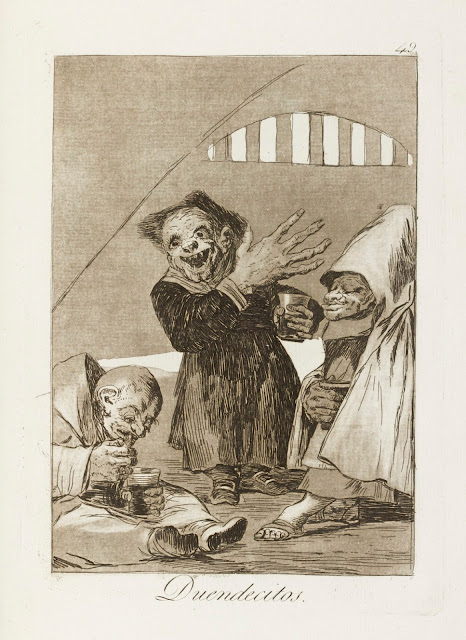
Image
Duendecitos Source: Royal Academy of Arts Today, Francisco Goya is known as one of the most creative and forward-looking artists of the late eighteenth and early nineteenth centuries. This was a turbulent time in Europe, marked by war, revolution, and intellectual and political upheaval. This chaos provided ample artistic subjects for Goya, and current events and social attitudes became frequent themes in his work. Hobgoblins ( Duendecitos in Spanish) comes from Goya’s Caprichos , a series of prints created around the turn of the century. These prints present a satirical image of Spanish society, criticizing the follies, superstitions, and ignorance of people from every walk of life. The creation of the Caprichos marks a major turning point in Goya’s artistic life. Throughout his early career, Goya worked as a court artist, focusing mostly on formal portraits and tapestry cartoons intended to decorate royal residences. Since this work was created for patrons, it was fairly conventio...
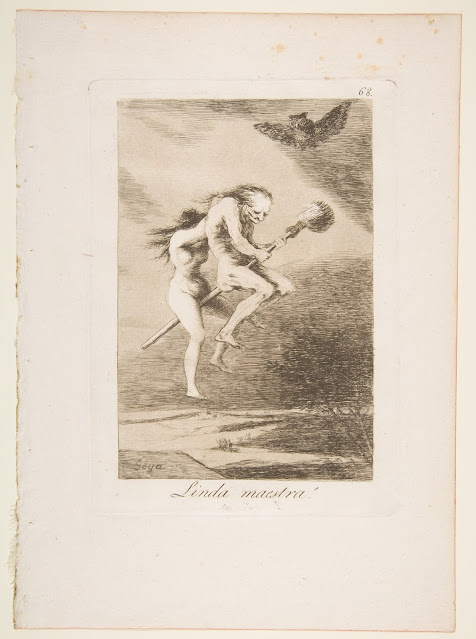
Pretty Teacher! (Linda maestra!) by Francisco Goya (Interpretation and Analysis)

Image
Linda maestra! Source: Metropolitan Museum of Art Francisco Goya can best be described as a visionary artist. Goya’s work was wildly original, and his art often touches upon strange and fantastical themes. He was certainly way ahead of his time compared to other eighteenth century Spanish artists. Goya’s print series Los Caprichos , published in 1799, is widely considered to be one the most influential artistic projects of its time. The Caprichos were not widely known at the time of their publication, but they had a resounding impact on art over the next hundred years. Although the Caprichos series explores themes of the Enlightenment—which is usually associated with logic and reason—many of the prints are incredibly dark, full of violence, chaos, and black magic. Thus, they’re perfect for Spooky Season (a.k.a. October). Two of the major themes in Los Caprichos are prostitution and witchcraft, both of which are closely related to the way Goya viewed social ills in contemporary Spani...

The Devil's Lamp (The Bewitched Man) by Francisco Goya (Interpretation and Analysis)

Image
The Devil's Lamp Source: Wikimedia Commons In honor of spooky season, I plan to share a piece of art that celebrates the creepy or the supernatural every day in October. And, there are few artists who imbue more magic and mystery in their art than Spanish painter and print-maker Francisco Goya. Goya, who is one of my favorite artists, is well known today for the fantastical and supernatural subjects that characterize much of his art. Goya returned to these themes many times throughout his career. They seem to have functioned as a way for Goya to express political or social beliefs that were controversial in Spain at the time. Goya was a firm proponent of the Enlightenment, an intellectual movement that sought to do away with superstition in favor of logic, reason, evidence based fact, and progress more generally. In his paintings, supernatural and magical apparitions represent the backwards social customs and superstition that plagued Spain at the time. Goya believed that Spain was...

The Adoration of the Shepherds by El Greco (Interpretation and Analysis)

Image
The Adoration of the Shepherds Source: Museo del Prado In this history of Western art, the painter El Greco stands out as one of the most unique artists of all time. I’ve written about El Greco many times on this blog. He was a visionary, a man who was ahead of his time in many ways. Although he worked in Spain during the sixteenth century, his work appears exceptionally modern to twenty-first century viewers. His work is characterized by distorted, elongated figures and a strange, grey-toned color scheme. His style has a painterly quality that gives it an energetic aura. Although some aspects of El Greco’s style (a name that literally means the Greek, a reference to the artist’s birth place) are in keeping with the Mannerist movement, his paintings exhibit a singular style totally unique to the artist. El Greco’s The Adoration of the Shepherds is particularly unusual. Although the adoration of the shepherds is a common motif in Christian art, El Greco’s interpretation of the subject s...

The Snowstorm or Winter by Francisco Goya (Interpretation and Analysis)

Image
The Snowstorm or Winter Source: Museo del Prado Happy December! I don’t know about you, but I was a little shocked to realize that we’re entering the last month of the year. Despite the craziness of 2020, it really flew by. Although it’s not technically winter yet, the beginning of December usually marks the change of seasons in my mind. In my neck of the woods, December means colder temperatures and snow. It even snowed today, so winter is very much on my mind. In honor of the snowy season, I’m going to focus on winter themed paintings from now until the end of the year. First up is one of Francisco Goya’s early works: The Snowstorm or Winter . Most scholars tend to associate Goya with his darker, more experimental works produced in the latter part of his career. Goya’s early works, produced while he worked as a court painter, tend to be much more conventional. Although, like all of Goya’s art, they contain surprising undertones and messages. The Snowstorm or Winter is a tapestry car...

The Crucified Christ by Diego Velazquez (Interpretation and Analysis)

Image
The Crucified Christ Source: Museo del Prado In the history of Western art, there are few painters better known and more revered than Diego Velazquez. Perhaps only the likes of Michelangelo, van Gogh, and Picasso are more famous; Velazquez is certainly the most important painter in the history of Spain. While Velazquez is best known for Las Meninas —a truly astonishing portrait—it is far from his only masterpiece. Velazquez’s Crucified Christ is a deeply moving and unique piece. As the title suggests, it depicts Christ’s crucifixion. He hangs dead upon the cross, radiating holy light. His body is painted in the polished perfection of classical style, yet Velazquez didn’t shy away from painting Christ’s pain and suffering. Blood runs down his face and his head hangs low. As the Prado Museum describes the painting, “The presence of a wound in his side, which occurred after Christ’s death, indicates that he has already expired, yet he seems to be holding his body in check on the Cross, ...

Witches' Sabbath or the Great He-Goat by Francisco Goya (Interpretation and Analysis)

Image
Witches' Sabbath or the Great He-Goat Source: Museo del Prado Spanish art Francisco Goya is one of my favorite painters. Throughout his long career, Goya produced hundreds of highly original paintings and prints. His work is often disturbing and frightening, but it is always imaginative and fascinating. Modern art historians usually regard Goya’s work to be ahead of its time; his art would not be amiss in an exhibition of Modernist or Surrealist paintings.  I had the privilege of seeing one of Goya’s most haunting masterpieces, Witches' Sabbath (also called The Great He-Goat ), in person when I visited the Prado Museum for the first time in 2012. It’s a massive painting that has a huge visual impact when you see it in person. It also made my skin crawl a little bit; I found it to be a highly creepy painting. The Great He-Goat is one of Goya’s “Black Paintings,” a group of fourteen images that he created while living in a house called Quinta del Sordo (which translates to the...

Witches' Flight by Francisco Goya (Interpretation and Analysis)

Image
Witches' Flight Source: Museo del Prado There are few artists who imbue more magic and mystery in their art than Spanish painter and print-maker Francisco Goya. The supernatural was a recurring theme in his work. In fact, it’s fair to say that Goya was fairly obsessed with witches, which feature heavily in his art. While this is true, Goya was not a believer in magic. In fact, Goya was a skeptic when it came to anything supernatural. He believed firmly in the logic and reason of the Enlightenment age, a frequent theme in his art. So, why was he so interested in witchcraft? For Goya, witches functioned as a symbol in his art. In his paintings, they represent the backwards social customs and superstition that plagued Spain at the time. Goya believed that Spain was being held back by a dogmatic adherence to medieval beliefs and superstition, which he subtly mocks in his witch paintings. The inclusion of witches in his art can also be read as a criticism of the Spanish Inquisition, whi...

The Dog by Francisco Goya (Interpretation and Analysis)

Image
The Dog Source: Wikimedia Commons During one art history class I took in college, the professor told us that she was about to show us one of the most disturbing (in her opinion) paintings in all of art history. That painting was The Dog by Francisco Goya, a piece that—more than any other—represents hopelessness and desperation. I saw The Dog at the Prado Museum The Dog is one of Goya’s “Black Paintings,” a group of fourteen images that he created while living in a house called Quinta del Sordo (which translates to the Villa of the Deaf). Wracked by mental and physical illness, Goya painted a series of horrific and sinister scenes on the walls. The Dog was one of these pieces. Later art historians have struggled to interpret the Black Paintings, but they generally agree that the paintings reflect the failings of humankind and Goya’s deep disappointment in the world and everything it represents. The Dog is one of the most haunting scenes in the series. It depicts a black dog trapp...

Out Hunting for Teeth (A Caza de Dientes) by Fancisco Goya (Interpretation and Analysis)

Image
Out Hunting for Teeth Source: MET Museum Francisco Goya’s print series Los Caprichos is widely considered to be one the most influential artistic projects of its time. The Caprichos were not widely known at the time of their publication, but they had a resounding impact on art over the next hundred years. Although the Caprichos series explores themes of the Enlightenment—which is usually associated with logic and reason—many of the prints are incredibly dark, full of violence, chaos, and black magic. Thus, they’re perfect for Spooky Season (a.k.a. October). A Caza de Dientes (which translates to Out Hunting for Teeth ) is one of the most disturbing scenes in the series. The piece depicts a young woman reaching into the mouth of a hanged man to extract his teeth. Her face is turned away in horrified disgust and she holds a cloth up to her cheeks as if it will defend her from the repulsive act she performs. The corpse hangs from a rope of the right, hands bound together and feet bare...

Witches Sabbath by Fancisco Goya (Interpretation and Analysis)

Image
Witches Sabbath Source: Wikimedia Commons In honor of spooky season, I plan to share a piece of art that celebrates the creepy or the paranormal every day in October. And, there are few artists who imbue more magic and mystery in their art than Spanish painter and print-maker Francisco Goya.  Goya was fairly obsessed with witches, and they feature heavily in his art. However, this is not because he believed in their power. In fact, Goya was a skeptic when it came to anything supernatural. He believed firmly in the logic and reason of the Enlightenment age, a frequent theme in his art. So, why was he so interested in witchcraft? For Goya, witches functioned as a symbol in his art. In his paintings, they represent the backwards social customs and superstition that plagued Spain at the time. Goya believed that Spain was being held back by a dogmatic adherence to medieval beliefs and superstition, which he subtly mocks in his witch paintings. The inclusion of witches in his art can als...

Ni así la Distingue (Even Thus he Cannot Make her Out) by Francisco Goya (Interpretation and Analysis)

Image
Ni así la Distingue Source: Museo del Prado Spanish artist Francisco Goya is known as one of the leading artists of the Enlightenment period. The Enlightenment was an intellectual movement that developed in eighteenth century Europe; the movement encouraged people and governments to act in more logical and rational ways that were based on scientific study and observation of the natural world. Goya, as a member of the Enlightenment movement, was particularly bothered by superstition and backwards social customs more generally. In a series of prints entitled Los Caprichos, Goya set out to identify and criticize the many faults of Spanish society, which was mired in centuries-old superstitions, corruption, and outdated social customs at the time. Goya was particularly interested in exploring the relationships between men and women, which were disproportionately dominated by hypocrisy and exploitation at the time. A large number of the Los Caprichos prints focused on this theme. Ni a...

¡Qué sacrificio! (What a sacrifice!) by Francisco Goya (Interpretation and Analysis)

Image
¡Qué sacrificio! Source: Wikimedia Commons Francisco Goya’s print series Los Caprichos is widely considered to be one the most influential artistic projects of its time. Although the Caprichos were not widely known at the time of their publication, they had a resounding impact on art over the next hundred years. One of the major themes of the series is the relationship between men and women. ¡Qué sacrificio! is an excellent example of this theme. The piece depicts a young woman in a white dress surrounded by a crowd of leering men. One man, whom Goya portrays as an oafish lout, leans toward her, examining her in a suggestive way. The woman, whom Goya portrays as the victim of the situation, looks away from the men, pain and distress evident on her face. The piece implies that the man is courting her in some way, with the title suggesting that the woman will be forced to accept his advances. The print offers a criticism of the social structures that forced young women to bind the...

Nadie Se Conoce (Nobody Knows Himself) by Francisco Goya (Interpretation and Analysis)

Image
Nadie Se Conoce Source: The Metropolitan Museum of Art As I have written many times, Spanish artist Francisco Goya was one of the most forward looking and inspired artists of his time. His work was extraordinary in terms of style and content, and his impact on art is immeasurable. However, it is his Caprichos series that ranks as one of his most astonishing artistic accomplishments. Goya published Los Caprichos —a series of etchings that depict the social ills of contemporary Spanish culture, in 1799—at the dawn of a new century that would change Spain forever. Nadie Se Conoce (which translates to Nobody Knows Himself ) is the sixth print in the series. The piece contains multiple layers of meaning. On the surface, it is a carnival scene with disguised men and women cavorting in the streets. Traditionally, carnival was a time when people could let loose and disregard traditional social roles and limitations. Thus, the festival functions as a liminal space in culture, acting as a ...

Restoration Regulation? The Case of Murillo’s Immaculate Conception

Image
The Botched Restoration of the Murillo's Immaculate Conception Source: Artnet News Today, I want to do something different and talk about an art story that is currently in the news. Several news outlets have recently reported a story about a botched attempt at art restoration in which a furniture restorer was hired by a private collector to clean a painting by the Spanish artist Bartolomé Esteban Murillo. The painting was a copy of one of Murillo’s most famous paintings, The Immaculate Conception of El Escorial . The person tasked with the restoration was paid just thirteen hundred dollars for his work, which permanently disfigured the face of the Virgin Mary, marring her beyond recognition. ( You can read about the story in more detail here .) This scandal has led to calls for regulation of the art restoration business. Such regulation would allow art restoration to be carried out only by trained professionals. Personally, I’m in favor of this. As an art lover, the idea that a...

Las Hilanderas by Diego Velázquez (Interpretation and Analysis)

Image
Las Hilanderas Source: Wikimedia Commons In the history of Spanish art, there is one name that stands out: Diego Velázquez. Velázquez is commonly regarded as the greatest of Spanish painters, only matched in talent and ingenuity by the likes of Francisco Goya and Pablo Picasso. Velázquez’s work is world renowned, and I would venture to say that his masterpiece, Las Meninas , is one of the most famous paintings in the world (it’s certainly in the top ten, if not the top five). The painting I’m going to discuss today, which is entitled Las Hilanderas ( The Spinners ) dates from the latter portion of his career, by which time Velázquez was well established in his role of court painter. At this point in his life, Velázquez had developed a well defined and confident style, which was marked by expressive brushstrokes and a sense of visual dynamism. Las Hilanderas depicts the story of Arachne, a legend from Greek mythology. According to legend, a mortal woman named Arachne challenged th...

Ya van Desplumados by Francisco Goya (Interpretation and Analysis)

Image
Ya van Desplumados Source: Wikimedia Commons I’ve written many times about my love for Francisco Goya’s work. Goya is one of my favorite artists. His work is endlessly interesting to me; his style is expressive and the content is often highly original and imaginative. One of the recurring themes in his oeuvre is the relationship between men and women. Goya was constantly interested in exploring human interactions and the way society treats certain individuals. Ya van Desplumados (which translates to There they go plucked) is an example of this aspect of his work. The print comes from the Los Caprichos series, a series of etchings that depict the social ills of contemporary Spanish culture. Ya van Desplumados depicts a group of prostitutes beating plucked birds with human heads with brooms. The birds represent the women’s clients. The implication is that they have “plucked” the men, stealing their money and possessions. Here, the women are portrayed as predators, preying on i...

Look how Solemn they Are! (Miren que Grabes!) by Francisco Goya (Interpretation and Analysis)

Image
Look how Solemn they Are! Source: MET Museum Today, I want to return to one of my favorite topics in art, Francisco Goya’s groundbreaking series of prints: Los Caprichos . Goya published Los Caprichos —a series of etchings that depict the social ills of contemporary Spanish culture, in 1799—at the dawn of a new century that would change Spain forever. This print, entitled Miren que Grabes! (which translates to Look how Solemn they Are! ) is the sixty-third print in the series. It presents a criticism of Spain’s hereditary nobility. Here, we see two monstrous “witches,” which many contemporary accounts identify as representatives of the nobility and clergy, sitting astride two donkey-like animals. It is noted that, “[o]ne of them is a courageous thief. The other is a fanatic savage. Such are the kings and principal magistrates of the towns. Even with all of this... [the people] acclaim them and trust them with their government.” Goya mocks the false righteousness and dignity of a...

Christ of Saint John on the Cross by Salvador Dalí (Interpretation and Analysis)

Image
Christ of Saint John on the Cross Source:  Basilica of the National Shrine of the Little Flower Although Salvador Dalí was well known for his stranger paintings, he also had a strong interest in portraying religious subjects. This wasn’t because Dalí—who was an extremely eccentric individual—was at all devout, but rather because he was interested in exploring the power of religious imagery. In essence, Dalí used art to forge a mystical connection to what he perceived to be divine. Christ of Saint John on the Cross is one of Dalí’s most interesting religious paintings. The piece depicts the crucified Christ from above, with the cross hanging seemingly unsupported in the sky. Christ’s body slumps off the cross, as if he is about to fall out of the sky. The graceful arc of his arms resembles the sweeping wings of a bird. Below, a seascape stretches to the horizon below, and a boat bobs in the water. This part of the scene is modeled on Port Lligat, where Dalí lived. The pa...

Third of May, 1808 by Francisco Goya (Interpretation and Analysis)

Image
Third of May, 1808 Source: Museo del Prado As today is the third day of May, I thought it only fitting to discuss Francisco Goya’s landmark masterpiece Third of May, 1808 . As you might imagine, the painting commemorates the events of May 3, 1808, a rather infamous day in the history of the Peninsular War. After the French—led by Napoleon Bonaparte—seized control of the Spanish government, many Spaniards rose in rebellion against their new French king. This uprising (the subject of another Goya painting) took place on May second. By May third, the uprising had been quashed and the rebels were being executed. Goya’s painting depicts these Spanish freedom fighters facing the firing squad. The central figure is a young man in a white shirt. He stands with his arms outstretched as he waits for his death. Art historians often compare this figure to depictions of Christ, noting that Goya uses traditional religious imagery to liken this man’s sacrifice for his nation to Christ’s death ...