Posts

Showing posts with the label Pre-Raphaelite

Saint Eulalia by John William Waterhouse (Interpretation and Analysis)

Image
Saint Eulalia Source: Wikimedia Commons Upon first glance, it may be hard to believe that John William Waterhouse’s Saint Eulalia depicts a Christian martyr. It is an extremely strange painting. The foreshortened, half-naked body of a young woman dominates the foreground while the middle ground—usually used to portray the main action of the piece—is empty. A group of onlookers huddles in the background while snow falls gently on the strange scene. The subject of this unconventional painting is the death of Eulalia of Mérida, a fourth-century Christian martyr from Spain. According to my research , Eulalia was persecuted because of her belief in Christianity and because she insulted the Roman gods. Eulalia, who was twelve to fourteen-years-old at the time, was sentenced to death by the local Roman governor. She was tortured and suffered a gruesome and excruciating martyrdom. Despite her pain, she taunted her torturers, and, when she died, a dove flew out of her mouth, a miracle that sym...

The Light of the World by William Holman Hunt (Interpretation and Analysis)

Image
The Light of the World Source: Keble College I’ve decided that this week is going to be religious art week on this blog. For seven days, I’ll be highlighting pieces of interesting religious art from the Western world. To kick things off, I want to take a look at one of the most popular devotional paintings in Victorian England: The Light of the World by William Holman Hunt. Hunt was a member of the Pre-Raphaelite Brotherhood; like all the members of this group, he sought to express “genuine ideas” and serious subjects through his art. For Hunt, this often meant executing religious works, such as The Light of the World . The painting depicts Christ standing in an autumnal landscape; he stands in front of a wooden door with his hand raised to knock. The scene illustrates a verse from the Book of Revelation: Behold, I stand at the door, and knock: if any man hear my voice, and open the door, I will come in to him, and will sup with him, and he with me. - Revelation 3:20 The verse is an ...

Trust Me by John Everett Millais (Interpretation and Analysis)

Image
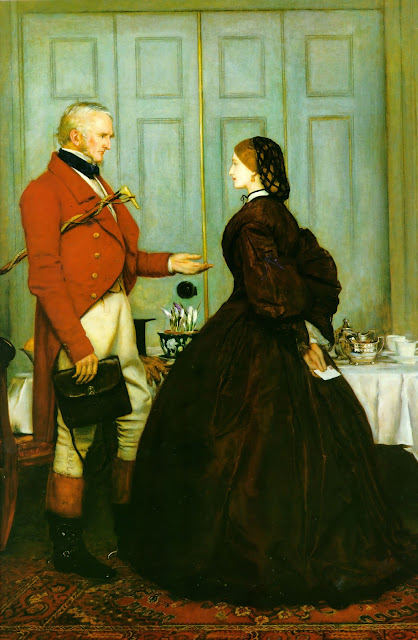
Trust Me Source: Arthive In the era before television and movies, visual art filled a unique role in society as both a source of entertainment and a medium for social and political statements. Thus, people in the Victorian age expected paintings to tell a story. Art could entertain or instruct or impart a religious message, but it nearly always contained some kind of narrative. John Everett Millais’ 1862 painting Trust Me is an excellent example of this aspect of nineteenth century art. The painting depicts a young woman and an older man, presumably a father and daughter, standing together in a breakfast room. The woman holds a letter behind her back while her father reaches out to take it from her. Although the daughter’s face is calm and impassive—not offering any hint to the contents of the letter—the father’s expression is stern and disapproving There is obvious tension in this scene, but the substance of the interaction is unclear. Contemporary newspapers that reported on The Roya...

The Two Princes Edward and Richard in the Tower by John Everett Millais (Interpretation and Analysis)

Image
The Two Princes Edward and Richard in the Tower Source: Wikimedia Commons When King Edward IV of England died in 1483, his two young sons found themselves in a difficult position. Although Edward IV’s oldest son should have become Edward V, the late king’s brother, Richard, Duke of Gloucester, imprisoned his two nephews in the Tower of London and declared himself King Richard III. What happened next is up for debate; however, young King Edward V and his brother Prince Richard never left the Tower again. It is assumed that the boys, aged twelve and nine, were either murdered for political reasons or fell ill and died. Shakespeare memorialized the story of the children in his famous play Richard III . The story of the princes in the Tower is one of the most famous and tragic mysteries in the history of England. To this day, historians speculate about the fate of the two young boys and the identity of their (assumed) murderer. In the seventeenth century, two child-sized skeletons were fou...

The Black Brunswicker by John Everett Millais (Interpretation and Analysis)

Image
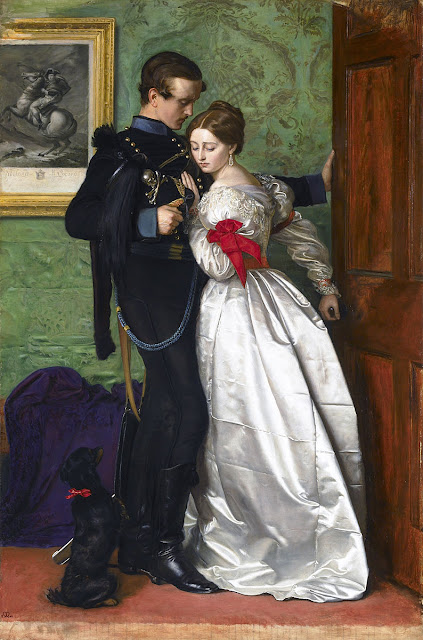
The Black Brunswicker Source: Wikimedia Commons English artist John Everett Millais is known for his dramatic art, but few paintings in his oeuvre tell a more heart-wrenching story than The Black Brunswicker . The piece depicts a young soldier and his sweetheart saying their goodbyes as he prepares to depart for battle. The title of the painting refers to the Black Brunswickers, a corp of German soldiers who became famous for bravery and sacrifice at the Battle of Waterloo. In the painting, The soldier pulls the door open, trying to leave, while the woman pushes it shut. A framed picture of Napoleon hangs in the background, illuminating the source of their conflict. The painting highlights the pain of separation. Almost all the Brunswickers were killed during the battle, suggesting that the couple in the painting might be parting for the final time. It is an emotional scene that is accentuated by Millais’ use of color. The soldier’s black uniform contrasts strongly with the lady’s whit...

The Vale of Rest by John Everett Millais (Interpretation and Analysis)

Image
The Vale of Rest Source: Wikimedia Commons For day two of John Everett Millais week, I want to take a look at a more staid, contemplative piece of art: The Vale of Rest . The title of this piece comes from composer Felix Mendelssohn's song Ruhetal , which translates to restful valley in German. Like Mendelssohn's song—which discusses the narrator’s final resting-place—Millais’ painting explores the theme of death. The piece depicts a graveyard at twilight. Two nuns are present, one is vigorously digging a grave, while the other woman sits on a headstone. Her face is turned toward the viewer, and her expression conveys pain and sadness. There is no sign of what they are burying or exhuming, but the nun’s anguished face and the skull on her rosary beads clearly signals death. Two wreaths rest next to the sitting nun, another sign that a funeral may be about to take place. A low wall surrounds the graveyard, and the belfry of a chapel can be seen in the distance. A purply, golden ...

The Rescue by John Everett Millais (Interpretation and Analysis)

Image
The Rescue Source: Google Arts & Culture I’ve decided that this week is going to be John Everett Millais week on this blog. In celebration of Millais’ work, I’m going to be sharing one of his paintings each day, and today I want to look at one of his most famous and dramatic paintings: The Rescue . The Rescue, also known as The Fireman , dates to the end of Millais’ Pre-Raphaelite period. Shortly after The Rescue was exhibited, Millais married Effie Gray and moved to Scotland, two events that coincide with a major shift in his artistic style. However, The Rescue is also unique in Millais’ oeuvre in that it is one of the first modern subjects he painted. Previously, Millais’ work focused on literary, religious, and historical subjects. The Pre-Raphaelite Brotherhood believed that art should depict serious subjects in a realistic way. In The Rescue , Millais applies these principles to a modern social problem: fire in London. The painting depicts a fireman carrying three children ...

The Somnambulist by John Everett Millais (Interpretation and Analysis)

Image
The Somnambulist  Source: Wikimedia Commons I’ve never seen anyone sleep walk; however, I imagine it’s quite the sight to behold. The idea of a person who is deeply asleep walking around as if they were awake is rather eerie and disconcerting. It’s no wonder that sleepwalking has been regarded as a mysterious and even supernatural act throughout history. John Everett Millais explores the psychological mystery of sleepwalking in The Somnambulist . The piece depicts a woman in a long, white nightgown walking through the night. Her expression is strangely blank, suggesting that she is in some sort of trance. She carries an extinguished candle in one hand, emphasizing the darkness and peril of the scene. To the left, it’s possible to see the edge of a cliff and dark water; the sleepwalker is only inches away from falling to her death, yet she is completely unaware of her danger. Millais had a flair for the dramatic. His paintings are full of characters facing grim and dangerous situa...

Speak! Speak! by John Everett Millais (Interpretation and Analysis)

Image
Speak! Speak! Source: The Tate The Pre-Raphaelite movement was truly an extraordinary time in the history of art. The Pre-Raphaelites threw out the rule book of art, rejecting the conventions of their age in favor of returning to an earlier style of art. As the name suggests, the Pre-Raphaelites were inspired by early Italian artists and the art of the Medieval age. Their work was characterized by realism and vibrancy. John Everett Millais was one of the most talented artists of his age. Although he began his artistic career as a Pre-Raphaelite, Millais later developed his own unique and mature style. Though he created many masterpieces, Millais himself considered Speak! Speak! to be one of his most serious and profound paintings. The piece, which was completed only a year before Millais’ death, tells a ghost story. As Millais’ son, John Guille Millais, relates: It is that of a young Roman who has been reading through the night the letters of his lost love; and at dawn, behold, the cu...

The Eve of Saint Agnes by John Everett Millais (Interpretation and Analysis)

Image
The Eve of Saint Agnes Source: Wikimedia Commons In the history of English art, there are few painters more famous or more prolific than John Everett Millais. Millais was one of the first artists in the modern age to achieve such profound success as a result of his art. Indeed, he was a baronet by the time he died.  Millais’ wife, Effie Gray, was one of the primary drivers of his financial and social success. She was also one of Millais’ favorite models and the most important artistic muse of his career. In fact, she features prominently in several of his most famous and acclaimed paintings. However, The Eve of Saint Agnes is the last major work that Effie modeled for. The subject of the piece is based on a poem of the same name by John Keats. The poem is based on the traditional belief that young women could see their future husband on the Eve of Saint Agnes. According to legend, the woman had to go to sleep without eating supper and perform a ritual with pins and a pincushion. T...

The Magic Circle by John William Waterhouse (Interpretation and Analysis)

Image
The Magic Circle Source: Wikimedia Commons As the month of October continues, I want to share another piece of art that captures the supernatural spirit of the Halloween season. Pre-Raphaelite painter John William Waterhouse returned to the idea of magic many times throughout his career. Over and over again, Waterhouse painted women engaged in acts of prophecy or enchantment. He was particularly fascinated by the mythological figure, Circe, a witch who plays a prominent role in Homer’s Odyssey. The Magic Circle , however, represents one of Waterhouse’s earliest forays into portraying witchcraft. The subject of the painting is opaque. The central figure is a woman in a long blue dress decorated with a warrior motif. She holds a crescent-shaped sickle in her hand, which links her to the moon and Hecate, according to my research . The background is vague and hazy, but it seems to represent some sort of arid climate. The woman seems to be in the middle of some sort of ritual. She stands o...

The Escape of a Heretic by John Everett Millais

Image
The Escape of a Heretic Source: Museo de Arte de Ponce There’s a particular type of dramatic history painting that is unique to the art of John Everett Millais. While Millais is typically known as a Pre-Raphaelite painter—not a group of artists typically known for dramatic scenes—he experimented with many different artistic styles and techniques during his long career. Despite this, Millais returned to one theme again and again throughout his artistic life: moments of great emotional drama seen through the lens of historical events. These pieces usually portrayed imagined historical figures escaping from extreme and dangerous situations, inspired by real historical events. The Proscribed Royalist, 1651, A Huguenot on St. Bartholomew's Day, The Ransom and The Martyr of Solway are all examples of this motif in his oeuvre. However, my favorite example of this theme in Millais’ work is The Escape of a Heretic . This genre is typically known as history painting. This style of history ...

Green Summer by Edward Burne-Jones (Interpretation and Analysis)

Image
Green Summer Source: Wikimedia Commons Happy summer! In honor of the first day of the season, I want to share a painting by the great Pre-Raphaelite artist Edward Burne-Jones. Burne-Jones stands out as one of the most productive and talented artists of his age; like many Pre-Raphaelites, he was driven by a desire to create serious and meaningful art. However, by the time Burne-Jones painted Green Summer in 1868, his art was beginning to move toward the values of the Aestheticism movement. Aestheticism in art is often defined as “art for art’s sake;” painters who embrace Aestheticism tend to prioritize the beauty of the piece and its aesthetic value over the meaning or moral significance of the painting. In many ways, the values of Aestheticism and Pre-Raphaelitism are completely opposite.  However, Burne-Jones continued to embrace the Pre-Raphaelite aesthetic in his work throughout his career. Famously, Burne-Jones’ paintings were heavily inspired by medieval artwork. This can be ...

Blind Girl by John Everett Millais (Interpretation and Analysis)

Image
Blind Girl Source: Wikimedia Commons When English painter John Everett Millais moved to Scotland in 1855, he began a new chapter of his artistic career. Although Millais is best known as a member of the Pre-Raphaelite brotherhood, he experimented with many different artistic styles and techniques during his long career. Blind Girl was painted during this transitional period in Millais’ artistic life. The piece depicts two young beggar girls on the road outside of the town of Winchelsea. The older girl is blind; a sign that says “Pity the Blind” hangs around her neck, marking her condition. She holds an accordion on her lap, suggesting that she plays music to earn a few coins. Although she is blind, the girl is clearly enjoying the day. She rubs a piece of grass between her fingers, and her blissful expression shows that she’s enjoying the warm sun on her face. In contrast, the younger girl—who is presumably the blind girl’s sister—gazes out at the vibrant, green landscape. This landsc...

A Souvenir of Velazquez by John Everett Millais

Image
A Souvenir of Velazquez Source: The Royal Academy John Everett Millais is known primarily as a Pre-Raphaelite artist. Indeed, it was his association with the fascinating and sometimes controversial Pre-Raphaelite brotherhood that initially brought Millais fame. However, by the end of his career, Millais had transcended the Pre-Raphaelite label. Throughout his long and storied career, Millais explored and experimented with different approaches and types of painting. A Souvenir of Velazquez is one example of this artistic flexibility. As the title suggests, the painting was inspired by the work of Spanish painter Diego Velázquez, one of the most important painters of the seventeenth centuries. Although Velázquez painted nearly two hundred years before Millais, he clearly found fresh inspiration in Velázquez’s work. A Souvenir of Velazquez makes use of the Spanish painter’s loose, brushy style. This approach to painting is very different from Millais’ Pre-Raphaelite work, which was const...

Christ in the House of His Parents by John Everett Millais (Interpretation and Analysis)

Image
Christ in the House of His Parents Source: Wikimedia Commons These days, artists of the Pre-Raphaelite movement have almost obtained the status of the “Old Masters.” The work of artists such as William Holman Hunt, John Everett Millais, and Dante Gabriel Rossetti is respected, studied, and carefully catalogued in the hallowed halls of museums around the world. So, it’s difficult to imagine how controversial Pre-Raphaelite art was when it was first created. Christ in the House of His Parents is perhaps the most controversial piece of art in the Pre-Raphaelite oeuvre. Millais created this masterpiece early in his career, when the Pre-Raphaelite movement was still new and not always appreciated in the art world. As the title suggests, the piece depicts Christ as a child in the house of his parents. Here, we see the Holy Family assembled in Joseph’s workshop, where Joseph is building a door on the workshop table. In the foreground, the Christ Child has injured his hand on a nail. The Virgi...

Peace Concluded by John Everett Millais (Interpretation and Analysis)

Image
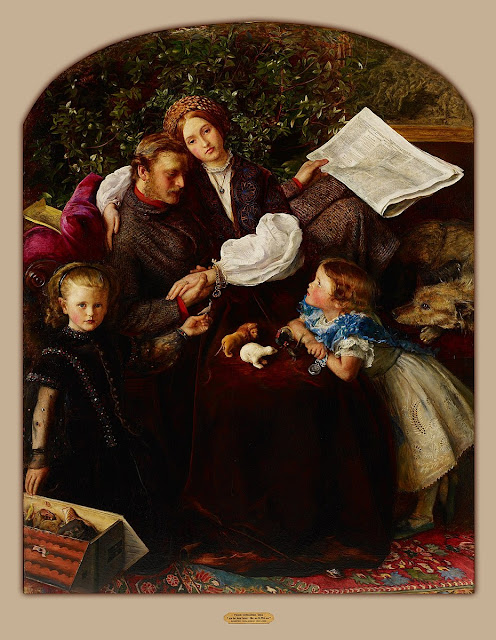
Peace Concluded Source: Wikimedia Commons Today, I’m continuing to explore the work of John Everett Millais, one of the most famous and prolific artists of the nineteenth century. When considering Millais’ vast oeuvre, it would be difficult to find a painting more beautiful or more serene than Peace Concluded . The painting depicts a wounded British army officer, who is surrounded by his family as he reads about the end of the Crimean War in the newspaper. His wife rests on the sofa with him, presumably sharing in the good news of peace. Two children play with animal figurines in front of their parents. One little girl holds a toy dove—a symbol of peace—while the other child seems to be playing with a rooster, a lion, a bear, and a turkey on her mother’s lap. Each one of these animals symbolize a different participant in the conflict. Originally, Millais intended the painting to be satirical, a criticism of officers who returned home to relax while common soldiers continued to fight. H...

The Order of Release by John Everett Millais (Interpretation and Analysis)

Image
The Order of Release Source: Wikimedia Commons I’ve decided that this is going to be the unofficial week of John Everett Millais on this blog. As a painter and as a person, I find Millais to be particularly interesting. Throughout his long and storied career, Millais explored and experimented with different approaches and types of painting. However, he is probably most famous as a Pre-Raphaelite artist. Later in his career, other artists and art critics would say that he abandoned his Pre-Raphaelite convictions for financial success as a more commercial painter. In my opinion, however, this change in his style was occasioned by growing maturity and a desire to expand his artistic horizons. The Order of Release  was one of Millais’ early masterpieces, painted during his early career when he was still closely associated with the Pre-Raphaelite movement. The Pre-Raphaelites espoused realism and tended to gravitate towards serious subjects, which were often imbued with rich symbolism. ...

Spring (Apple Blossoms) by John Everett Millais (Interpretation and Analysis)

Image
Spring of Apple Blossoms Source: Wikimedia Commons Today is the first day of spring! To celebrate the changing of the seasons, I wanted to share a painting that represents the season of spring.  Spring or Apple Blossoms was created by British artist John Everett Millais at a time of transition in his own life.  Millais is an extraordinary figure in the story of British art. Throughout his long career, he enjoyed a level of fame, public recognition, and commercial success that was almost unprecedented among professional artists. Millais was one of the leading painters of the Pre-Raphaelite movement, a group of  painters who rejected “trivial” scenes of everyday life, preferring to focus on subjects that were rich in symbolism, including religious, mythological, literary, and historical scenes.  However, when Millais painted Spring, he was starting to move away from his Pre-Raphaelite roots. In 1855, Millais married Effie Gray* (the well-known ex-wife of art critic J...

The Knight Errant by John Everett Millais (Interpretation and Analysis)

Image
The Knight Errant Source: The Tate The Pre-Raphaelite movement was truly an extraordinary time in the history of art. The Pre-Raphaelites threw out the rule book of art, rejecting the conventions of their age in favor of returning to an earlier style of art. As the name suggests, the Pre-Raphaelites were inspired by early Italian artists and the art of the Medieval age. Their work focused on realism and vibrancy, rich and energetic. John Everett Millais was one of the most talented artists of his age. Although he began his artistic career as a Pre-Raphaelite, Millais later developed his own unique and mature style. The Knight Errant is an example of this unique style. The painting depicts a traditional Medieval theme, the Knight Errant. Here, we see a knight clad in armor rescuing a woman who has been stripped and tied to a tree. Millais's inscription, which accompanied the painting, read, “The order of Knights errant was instituted to protect widows and orphans, and to succour mai...