Posts

Showing posts with the label Pieter Bruegel the Elder

The Census at Bethlehem by Pieter Bruegel the Elder (Interpretation and Analysis)

Image
The Census at Bethlehem Source: Wikimedia Commons As Christmas approaches, I decided to share some festive art to get everyone in the holiday spirit! Today, we’re going to take a look at The Census at Bethlehem by Pieter Bruegel the Elder, one of the greatest and most interesting painters in Western history. Bruegel is the quintessential Northern Renaissance artist. His style is unique and eclectic, reminiscent of the work of Hieronymus Bosch in its oddity. Today, Bruegel is known for his distinctive landscapes, scenes of everyday life, allegorical paintings, and his Northern Renaissance panache in general. The Northern Renaissance—a term I’m using pretty loosely here—refers to an artistic movement in northern Europe that occurred at roughly the same time as the Italian Renaissance. Art of the Northern Renaissance is characterized by increased attention to the accurate portrayal of three dimensional space and greater realism in the depiction of the human form. However, art of the Nort...
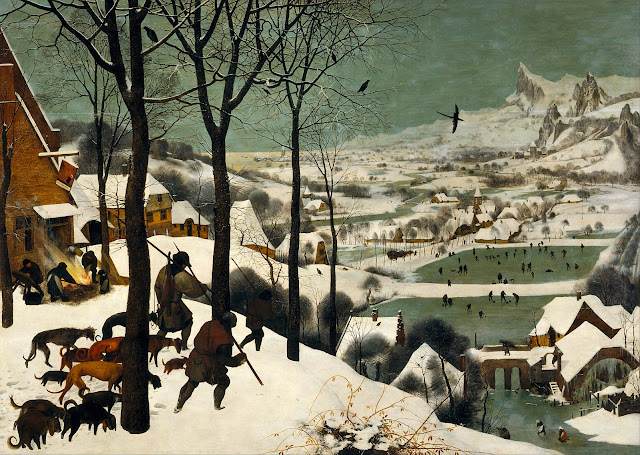
The Hunters in the Snow by Pieter Bruegel the Elder (Interpretation and Analysis)

Image
The Hunters in the Snow Source: Wikimedia Commons Pieter Bruegel the Elder is the quintessential Northern Renaissance artist. His style is unique and eclectic, reminiscent of the work of Hieronymus Bosch in its oddity. Today, Bruegel is known for his distinctive landscapes, scenes of everyday life, allegorical paintings, and his Northern Renaissance panache in general. The Hunters in the Snow is one of his most famous paintings. It depicts a small village awash in white, fluffy snow. In the foreground, a group of hunters return from their work accompanied by a pack of curly-tailed dogs. They walk downhill toward the village, where some of the townspeople are at work while others skate on the ice. In the background, craggy mountains loom over the scene. The painting is rich in detail, executed with loving and painstaking precision. On the surface, The Hunters in the Snow seems to be a straightforward, secular painting. However, taken in the context of Bruegel’s life, it is a wistful, ...

The Fall of the Rebel Angels by Pieter Bruegel the Elder (Interpretation and Analysis)

Image
The Fall of the Rebel Angels Source: Wikimedia Commons Pieter Bruegel the Elder is the quintessential Northern Renaissance artist. His style is unique and eclectic, reminiscent of the work of Hieronymus Bosch in its oddity. Today, Bruegel is known for his distinctive landscapes, scenes of everyday life, allegorical paintings, and his Northern Renaissance panache in general. The Northern Renaissance (a term I’m using pretty loosely here) refers to an artistic movement in northern Europe that occurred at roughly the same time as the Italian Renaissance. Art of the Northern Renaissance is characterized by increased attention to the accurate portrayal of three dimensional space and greater realism in the depiction of the human form. However, art of the Northern Renaissance lacks the grandiose style of its Italian counterparts; instead, northern artists focused on more down-to-Earth scenes of everyday life and religious subjects. One such religious painting is Bruegel’s The Fall of the ...

The Big Fish Eat the Little Fish by Pieter Bruegel the Elder (Interpretation and Analysis)

Image
The Big Fish Eat the Little Fish Source: The MET Today, I want to talk about a very strange engraving: The Big Fish Eat the Little Fish . According to the MET , the title of the print refers to a Latin proverb, which refers to the universal tendency of the powerful to prey on the weak. Although the meaning of the proverb is fairly obvious, the print itself is rather bizarre. The focal point is a massive fish, beached upon the shore. A man with a large knife slits the fish open, revealing dozens of smaller fish stuffed inside. The background is dotted with fantastical images of fish devouring each other and other, stranger creatures such as a flying fish and a fish walking on human legs. In the distance, the faint outline of a city is visible, its docks crowded with the masts of ships. The visual style of the engraving is clearly inspired by the work of Dutch painter Hieronymus Bosch. In fact, the knife in the center of The Big Fish Eat the Little Fish is a direct reference th...