Posts

Showing posts with the label Puerto Rican Art

Baquiné Series by José R. Alicea (Interpretation and Analysis)

Image
There are few subjects in Puerto Rican art that carry more emotional and cultural significance than the baquiné . The baquiné is a traditional practice that has its roots in African cultures; the ceremony, which is essentially a wake, celebrates the child’s ascension to Heaven after his or her death and is underpinned by the belief that the dead infant is now an angel.  Baquiné II (El gran ciempiés) Source: Museo de Arte de Puerto Rico Naturally, this sad, yet poetic, subject inspired much creative and emotional outpouring. In fact, the baquiné is the subject of one of the most famous paintings in Puerto Rico’s history: Francisco Oller’s El Velorio .  Baquiné III (Zape, zape, zape) Source: Museo de Arte de Puerto Rico Which is why José Alicea’s Baquiné series is such an important group of paintings in the story of Puerto Rico. Alicea, who studied with the great Puerto Rican artist Miguel Pou, is best known today for his prints and woodcuts. This particular series of prints ...

Between Two Worlds by Myrna Báez (Interpretation and Analysis)

Image
Between Two Worlds Source: Museo de Arte de Puerto Rico Myrna Báez is one of the seminal artists of Puerto Rico’s modernist movement. Báez, who studied in Spain, produced very distinctive work. She was heavily influenced by impressionism and surrealism; there are even elements of cubism in her style. Although Báez didn’t want to be purely identified as a Puerto Rican artist, her work was certainly informed by her heritage. In particular, Between Two Worlds explores her Puerto Rican identity. The piece portrays a road that runs next to a field, a typical scene in the Puerto Rican countryside. A shadow falls over approximately two thirds of the painting with rectangular chunks removed to show the brighter colors underneath. To the left, a woman walks down the road; her face is blurred, as if captured in motion. The color contrast represents the two worlds referenced in the title, while the walking woman symbolically represents the liminal space between these worlds. The exact ident...

Las Tentaciones de San Antonio by Rafael Trelles (Interpretation and Analysis)

Image
Las Tentaciones de San Antonio Source: Museo de Arte de Puerto Rico Puerto Rican artists have a long and proud tradition of excellence in modernist art. However, the work of painter Rafael Trelles stands alone when it comes to creativity and originality.  Trelles, who studied in both Mexico and Spain as well as in Puerto Rico was inspired by the Surrealist movement as well as by mythology and world literature. These fantastical influences are on full display in his painting Las Tentaciones de San Antonio (which translates to The Temptation of Saint Anthony ). The piece depicts an incident from the life of Saint Anthony the Great, a Christian hermit who lived in the wilderness in Egypt. He was best known by European Christians for the many temptations he endured. As the story goes, during his journey into the desert, the devil confronted the saint with many temptations (including, among other things, boredom, laziness, and naked women) in an attempt to break his faith. Natura...

La Rogativa by Lindsay Daen (Interpretation and Analysis)

Image
La Rogativa Pinterest Puerto Rico is an island rich in art. I’ve written many times about Puerto Rican paintings, however I haven’t discussed sculpture in much detail. One of Puerto Rico’s most famous public sculptures is entitled La Rogativa , and is fittingly located in La Plaza de la Rogativa in Old San Juan, the historic district of Puerto Rico’s capital city.  The subject of the sculpture is taken from San Juan’s famous story of la rogativa (I should note that La Rogativa translates to The Procession ). According to local legend, when the British attacked San Juan in 1797, the bishop led a procession of citizens through the streets to pray to God for deliverance. When the British saw the streets fill with people and heard the sounds of the procession, they thought that Spanish reinforcements had arrived and fled the city. Although this probably didn’t really happen, the legend of la rogativa is symbolically important, representing the idea that Puerto Rico can defend it...

La Venus Roja by Myrna Báez (Interpretation and Analysis)

Image
La Venus Roja Source: Museo de Arte de Bayamón Myrna Báez is one of the seminal artists of Puerto Rico’s modernist movement. Báez, who studied in Spain, produced very distinctive work. She was heavily influenced by impressionism and surrealism; there are even elements of cubism in her style. She experimented with different color schemes and with light and shadow in her paintings. According to the Museo de Arte de Puerto Rico, “Báez is known for her technical experimentation in painting and…[for] her depiction of ambiguous interior spaces that layer and merge the landscape and the human figure.” Báez’s Spanish education is particularly on display in her masterpiece La Venus Roja (which translates to The Red Venus ). Here, Báez creates a visual criticism of the work of Diego Velázquez, one of the great artists in the history of Spain. The title of the piece references Velázquez’s Rokeby Venus , in which the nude goddess gazes at herself in a mirror held by Cupid. Báez bo...

Vieques Amado by Augusto Marin (Interpretation and Analysis)

Image
Vieques Amado Source: Pinterest The twentieth century was a good time for Puerto Rican art, producing many of the island’s artistic luminaries. However, few twentieth century Puerto Rican artists are as well-known as Augusto Marin. Marin’s style evolved constantly throughout his career; his work was always on the edge of experimentation, combining Modernist styles with Caribbean themes and colors. Puerto Rican history and politics were major subjects in his art, and the painting I’m discussing today— Vieques Amado —is an excellent example of this aspect of his work. The title of the piece (which translates to Beloved Vieques ) references the island of Vieques, a small island off the coast of Puerto Rico that is considered to be part of the Puerto Rican territory. For many years, the United States Navy used the island as a bombing range, a source of great anger and sadness for many Puerto Ricans. When Marin created Vieques Amado in the year 2000, the island was the source of prot...

Olga by Francisco Rodón (Interpretation and Analysis)

Image
Olga Source: El Museo del Barrio Among Puerto Rican portrait artists, few are better known than Francisco Rodón. Rodón was a major portraitist during the twentieth century. While many contemporary artists chose to focus on more rural, countryside scenes, Rodón’s art often portrayed members of high society, capturing the likenesses of Argentinian writer Jorge Luis Borges, Cuban dancer Alicia Alonso and Peruvian writer Mario Vargas Llosa, and Puerto Rico’s first democratically elected governor Luis Muñoz Marín. The painting I selected today— Olga —is a great example of his skill as a portraitist. The piece depicts Puerto Rican artist Olga Albizu, who was famed for her pioneering abstract paintings. (I should clarify that I think the painting depicts Albizu. I attempted to research who the painting portrays, and I couldn’t find any details. However, I think it’s Albizu because it looks like her, and the two artists were contemporaries. In any case, if it doesn’t portray Albizu, that ...

Red Cows by Myrna Báez (Interpretation and Analysis)

Image
Red Cows Source: El Museo del Barrio For some reason or another, cows are a perpetual and common subject in fine art. It is perhaps natural that they should be so. Cows have lived alongside humans for thousands or years and have become symbols of country life, prosperity, fertility, and more depending on the culture. However, in Myrna Báez’s painting, Red Cows ( Vacas Rojas ), they have a double meaning. Báez, a Puerto Rican artist, produced highly distinctive work. She studied in Spain and was heavily influenced by impressionism and surrealism; there are even elements of cubism in her style. She tends to use cool tones in her paintings and experiments heavily with light and shadow. Red Cows exemplifies these characteristics. Here, Báez uses the cow to experiment with shape and colors within the landscape. The result is an otherworldly scene: a herd of bright red cows arranging themselves in geometric patterns. While the animals are clearly cows, their shape and color are rem...

Bolívar Marquez by José R. Alicea (Interpretation and Analysis)

Image
Bolívar Marquez Source: Flint Institute of Arts For the past two days, I’ve been discussing the art of conflict and how artists respond to war. I’m going to continue that today with a look at a different kind of conflict: political struggle. Art has long been a part of politics and political conflict. It is an excellent tool for spreading political messages and ideas; and history is dotted with political posters and paintings that changed hearts and minds. In the history of Puerto Rican art, political art tends to bend towards one cause: Puerto Rican independence and an end of colonialism. José Alicea clearly demonstrates this tendency in his print Bolívar Marquez . The print references a real historical event—the Ponce Massacre—however, Alicea’s print is more interested in conveying a political message than documenting the event itself. The Ponce Massacre occurred On Palm Sunday, March 21, 1937, when members of the Puerto Rican Nationalist Party and other civilians gathered in...

Collar y Cemí by José R. Alicea (Interpretation and Analysis)

Image
Collar y Cemí Source: The Museum of Modern Art When examining Puerto Rican art, you will find that the Taino people—Puerto Rico’s original inhabitants—are a recurring theme. Many Puerto Rican artists draw inspiration from the artifacts of Taino culture, taking advantage of their distinctive visual style to create bold and meaningful art. The idea that modern Puerto Ricans are connected to the Tainos—either genetically or culturally—is an important cornerstone of Puerto Rican identity and an underpinning concept in the Puerto Rican nationalist movement. Puerto Rican artist José Alicea explores this idea in his print Collar y Cemí . Alicea is one of many Puerto Rican artists who became interested in printmaking in the mid to late twentieth century. Today, he is well known for his prints and woodcuts and for his interest in portraying social and historical subjects. At first glance, Collar y Cemí appears to be a drawing of a Taino collar, a ritual item often uncovered at archeologi...

Platanal by Myrna Báez (Interpretation and Analysis)

Image
Platanal Source:  Smithsonian American Art Museum The plantain is an enduring symbol of Puerto Rican art. A cheap and plentiful food source, it has become a symbol of the Puerto Rican culture and lifestyle. The plantain is particularly linked to the jíbaros , the island’s subsistence farmers who are associated with a more traditional way of life. As such, plantains are plentiful in Puerto Rican art; however, Puerto Rican painter Myrna Báez puts a new spin on the subject in her painting Platanal . Báez’s work is very distinctive. She studied in Spain and was heavily influenced by impressionism and surrealism; there are even elements of cubism in her style. She tends to use cool tones in her paintings and experiments heavily with light and shadow. Platanal includes all these aspects of her work. It depicts a highly stylized, slightly abstract version of a plantain plantation, the plants stretching as far as the eye can see to the horizon. Mountains can be seen in the backgro...

El Arbol de los Despojados by Augusto Marin (Interpretation and Analysis)

Image
El Arbol de los Despojados Source: La Fundación de las Artes Augusto Marín Without a doubt, Augusto Marín is one of the most important and famous Puerto Rican artists of the twentieth and twenty-first centuries. Although his style tends toward abstraction, Marín’s paintings often draw inspiration from more traditional themes and famed pieces of Western art. This drawing, entitled El Arbol de los Despojados (which translates to The Tree of the Bereft ) is one such example of this phenomenon. As the title suggests, the drawing depicts a tree that appears to be composed of the twisted bodies of human beings. At the top of the tree, a horned figure (which appears to represent the Devil) stretches his arms up to the sky. The disembodied head of a horse lays behind him. El Arbol de los Despojados is undoubtedly strange and sinister, but it has its roots in the idea of the Tree of Life, a mythological idea prevalent in Western art (and in art around the world). Generally, the Tree of Li...

Virgen Negra by Marta Pérez (Interpretation and Analysis)

Image
Virgen Negra Source: Museo de Arte de Puerto Rico Puerto Rican artist Marta Pérez is known for her lavish, allegorical paintings. Her work draws on the bright and vibrant motifs of Caribbean culture and on her own cultural heritage (Pérez has connections to Basque, Jewish, Greek, and Irish culture). Virgen Negra —which loosely translates to Black Madonna—is perhaps my favorite Pérez painting. As the title suggests, the painting depicts the Virgin Mary with the Christ Child on her lap. The mother and son are surrounded by a bizarre landscape of ghostly blue trees, purple fish, and a magenta sky. The pose of the Madonna and Child suggests that Pérez may be referencing the Black Madonna of Montserrat, one of the most important spiritual icons in Spain. Such a reference suggests that Pérez is exploring the way European Christianity has come to function in the Caribbean. Her landscape is an allegorical representation of the multicultural world created by the transcontinental exchange of...

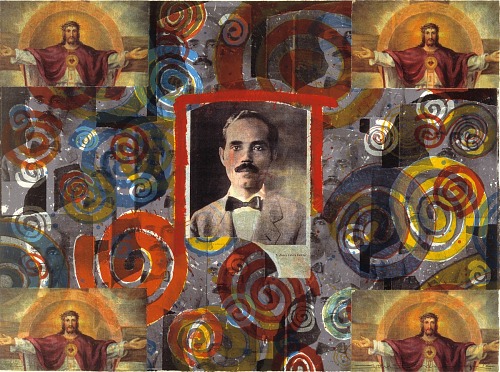
Para Don Pedro by Juan Sánchez (Interpretation and Analysis)

Image
Para Don Pedro Source: Smithsonian American Art Museum When studying modern Puerto Rican art, you may notice that one figure crops up again and again: Pedro Albizu Campos. Albizu Campos—who was a well-known political leader in the Puerto Rican nationalist movement in the 1950s and 60s—is an important subject in Puerto Rican art. As a proponent of independence, he has become synonymous with the preservation of Puerto Rican culture, strength, leadership, and national pride. Nuyorican artist Juan Sánchez explores this idea in his collage Para Don Pedro . The collage centers on a photograph of Albizu Campos, which in turn is surrounded by smaller images of Christ with his arms outstretched in blessing. Albizu Campos was imprisoned for his political activities, and evidence later emerged that he had been subjected to human radiation experiments while in prison, which probably played a major role in his death shortly after his release. This series of events led many people to view him ...

Examining the Art of Vejigante Masks

Image
Careta Mask at the Museo de Arte de Ponce Source: Personal Photograph Yesterday, I wrote about the artistic legacy of Afro-Caribbean culture in my discussion of Wifredo Lam’s Rumblings of the Earth. Today, I want to continue that discussion by examining one of the most recognizable forms of Puerto Rican art: Vejigante masks. These masks, called careta , are traditionally worn during carnival in the Puerto Rican cities of Ponce and Loiza. Vejigante figures, who wear the masks, represent a demonic character from Spanish folklore, and their presence in modern religious festivals can be loosely interpreted as a symbol of triumph over the devil and forces of evil more generally. In truth, in Puerto Rico, the tradition of the vejigante has more to do with the cultural traditions of the Taino people and of the African slaves who were brought to Puerto Rico by Spaniards. When you examine the history of colonization in Latin America, you will often find that indigenous peoples di...

Betancinados by Yiyo Tirado Rivera (Interpretation and Analysis)

Image
Betancinados Source: Princeton University As a medium, printmaking seems to have fallen out of fashion among modern artists (at least that’s my perception). However this print, entitled Betancinados , was created in 2016 by Puerto Rican artist Yiyo Tirado Rivera. The print is dominated by the face of Ramón Emeterio Betances, one of the celebrated leaders of the Grito de Lares, an armed rebellion against Spanish colonial forces. Although the revolt failed, Betances remains an enduring symbol of freedom and the cause of Puerto Rican independence. In Tirado’s print, Betances’ beard has been transformed into a charging army on horseback. This army is symbolic of both the Grito de Lares and, in a more abstract sense, the ideas it created. While the image can be read literally as Betances leading an army against Spain, the army can also be understood as Betances’ ideas, flowing from his mind out into the world. These men on horseback represent the intellectual descendents of Betances’ mo...

El Nacimiento de Venus by Augusto Marín (Interpretation and Analysis)

Image
El Nacimiento de Venus Source: La Fundación de las Artes Augusto Marín Without a doubt, Augusto Marín is one of the most important and famous Puerto Rican artists of the twentieth and twenty-first centuries. Although his style tends toward abstraction, Marín’s paintings often draw inspiration from more traditional themes and famed pieces of Western art. This painting, El Nacimiento de Venus (which translates to The Birth of Venus ), takes its impetus from Sandro Botticelli’s painting of the same name. Botticelli’s Birth of Venus is one of the most recognizable paintings of the Renaissance period; in fact, it’s one of the most famous paintings in the Western world. The subject matter comes from classical mythology, depicting the moment that that the goddess Venus emerged from the sea as a fully grown woman; Venus is traditionally considered to be born of the sea-foam. She is the goddess of love and fertility in the Roman pantheon. Birth of Venus Source: Google Art Projec...

Untitled by Marta Pérez García (Interpretation and Analysis)

Image
Untitled Source: Museo de Arte de Puerto Rico The beauty of the natural world is a common theme in Puerto Rican art. Painters like Francisco Oller, Miguel Pou, and Augusto Marin often celebrate the island’s natural abundance, especially the rich variety of plants grown on the island. This untitled painting by Puerto Rican artist Marta Pérez García continues in this tradition, albeit in a much less figurative style. García’s piece takes familiar elements of the Puerto Rican landscape—such as snakes, birds, lizards, and leaves—and strips them down to their essential elements. What remains is an abstracted vision of Puerto Rico, painted in vibrant shades of purple, blue, green, and orange. These colors are a large part of what makes the painting so attractive. The bright colors and rich textures of the untitled piece draw the viewer’s eye while creating an aura of warmth and energy. While this painting is a clear celebration of the natural world, there is also a darker element within...

The Transculturation of the Puerto Rican by Carlos Irizarry (Interpretation and Analysis)

Image
The Transculturation of the Puerto Rican Source: Museo de Arte de Puerto Rico  Although artistic ideals and styles shift over time, one aspect of art remains constant: the artists of the past inspire the artists of the future. Carlos Irizarry’s painting The Transculturation of the Puerto Rican is a good example of this phenomenon. Irizarry drew his inspiration from Ramón Frade’s famous painting El Pan Nuestro de Cada Dia . Frade’s painting celebrates Puerto Rico’s traditional jíbaro lifestyle. The jíbaro way of life was primarily an agricultural culture in which subsistence farmers live off the land in a traditional way. Of course, this lifestyle is fraught with difficulties; however, it has long been romanticized by those who believe the jíbaro lifestyle has inherent honor and dignity. To some modern observers, the jíbaro lifestyle represents a simpler way of life that preserved the Puerto Rican culture and allowed everyday people to become self-sufficient property owners...

Ponce Massacre by Carlos Raquel Rivera (Interpretation and Analysis)

Image
Ponce Massacre Source: Princeton Program in Latin American Studies In the history of human culture, art has served many different purposes. It commemorates past events, conveys political messages, expresses complex ideas, inspires religiosity, and adds a degree of beauty to the world. Today, I’m going to talk about a piece of art that serves as a historical record of a little-remembered event: the Ponce Massacre of 1937. Carlos Raquel Rivera’s linocut print, aptly entitled Ponce Massacre , commemorates the massacre of the same name that killed nineteen people in Ponce, Puerto Rico. On Palm Sunday, March 21, 1937, members of the Puerto Rican Nationalist Party and other civilians gathered in the main plaza of the city of Ponce to stage a march in protest of the unjust imprisonment of Pedro Albizu Campos, a key figure in the Puerto Rican struggle for independence. All protesters were unarmed, and the organizers had obtained permits for the protest. However, On the day of the protest, ...