Posts

Showing posts with the label Caravaggio

The Taking of Christ by Caravaggio (Interpretation and Analysis)

Image
The Taking of Christ Source: Wikimedia Commons Baroque painter Caravaggio is famous for his religious paintings. While Caravaggio himself was well-known for his temper and his devil-may-care attitude, his greatest works depict scenes from the life of Christ and the saints. One of his greatest masterpieces, The Taking of Christ , depicts Christ’s arrest in the garden after being betrayed by Judas: While he was still speaking, Judas, one of the Twelve, arrived. With him was a large crowd armed with swords and clubs, sent from the chief priests and the elders of the people. Now the betrayer had arranged a signal with them: “The one I kiss is the man; arrest him.” Going at once to Jesus, Judas said, “Greetings, Rabbi!” and kissed him. Jesus replied, “Do what you came for, friend.” Then the men stepped forward, seized Jesus and arrested him. - Matthew 26:47-50 In The Taking of Christ , Caravaggio captures the moment that Judas kisses Christ. To the left, Saint John cries out in alarm while ...

Sacred Love and Profane Love by Giovanni Baglione (Interpretation and Analysis)

Image
Sacred Love and Profane Love Source: Wikimedia Commons Today is Valentine’s day, the day most often associated with love in the Western world. Although Valentine’s day usually focuses on the idea of Romantic love, today I want to share a painting that explores a different sort of love. Sacred Love and Profane Love is the masterpiece of Italian artist Giovanni Baglione (who is best known in modern times as the artist who took Caravaggio to court for libel). In this piece, Baglione explores two different types of love: the sacred and the profane. By the seventeenth century, sacred love had long been a topic of philosophical and theological discussion. The ideas of the Greek philosophers were rediscovered in Europe in the fifteenth century, leading Christian scholars and theologians to examine the idea of Platonic love and agape , a concept usually used to describe the love between human beings and God. Sacred love was generally seen to be a pure sort of love: selfless, charitable, and u...

The Craziest Self-Portraits of all Time

Image
For one reason or another, self-portraits are massively popular in the world of art. There are many possible explanations for this. For obvious reasons, most people are deeply interested in themselves, and self-portraits eliminate the need for a willing and cooperative model. However, the genre of the self-portrait also offers unique opportunities for experimentation and introspection that are unavailable in other forms of art. That being said, some self-portraits are just plain weird and crazy. So, today I’m going to share some of the most unusual self-portraits I could find. Let’s dive in! The Desperate Man by Gustave Courbet - I have to be honest, this self-portrait holds a sort of panache that is almost unparalleled in art history. The Desperate Man captures the artist Gustave Courbet at the tender age of twenty-four. The self-portrait portrays Courbet in a moment of emotional turmoil. The artist stares wildly out at the viewer as he runs his fingers through his hair. His shirt bi...

The Calling of Saint Matthew by Caravaggio (Interpretation and Analysis)

Image
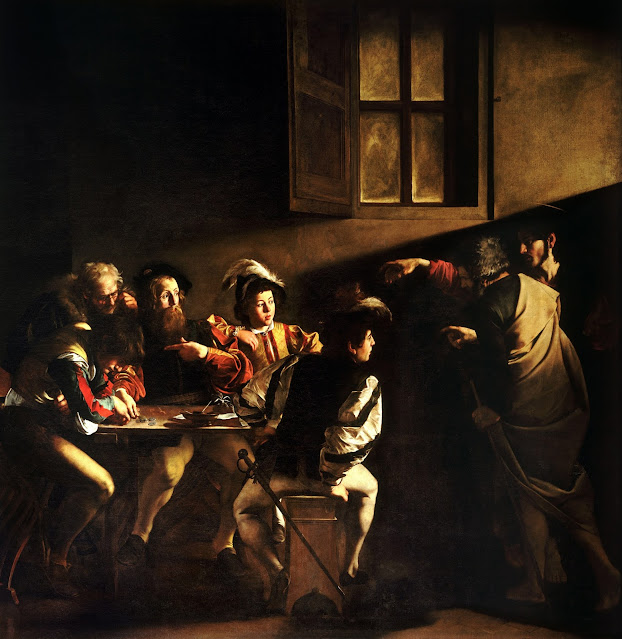
The Calling of Saint Matthew Source: Wikimedia Commons There are few artists more famous and interesting than Caravaggio. He is often known as the greatest painter of the Baroque movement. The Baroque movement revolved around emotion. Baroque artists sought to capture heightened states of feeling and spiritual exaltation. They achieved this through visual drama, movement, twisting shapes, and intense contrast between shadow and light.  Caravaggio’s art was incredibly effective. It was shocking and unusual for his time, but Caravaggio ensured constant patronage through his talent for conveying believable emotion and drama through substantial, weighty figures. Caravaggio is also famous for his gritty, down-to-earth scenes that featured men and women who were reminiscent of Rome’s petty criminals. In fact, Caravaggio often used the common, “disreputable” people that he met in taverns as models, a fact which scandalized some wealthy, high-class Italians. The Calling of Saint Matthew i...

The Martyrdom of Saint Ursula by Caravaggio (Interpretation and Analysis)

Image
The Martyrdom of Saint Ursula Source: Wikimedia Commons When it comes to art, there are few things more appealing than the lavish visual drama of a Caravaggio painting. Caravaggio most famous artists of the Baroque era: Caravaggio. Caravaggio was a master of light and shadow; his work experiments with chiaroscuro and tends to be visually dramatic, two major characteristics of Baroque art. The Martyrdom of Saint Ursula is probably the last image Caravaggio ever painted, and it is a fine example of his style and talent. The piece depicts a scene from the life of Saint Ursula, a fourth century martyr. Although there are many stories about her life that are probably apocryphal, most written accounts agree that Ursula was the daughter of a king who wanted his daughter to marry a pagan nobleman. Before her wedding, Ursula decided to complete a pilgrimage. As she journeyed through Europe with her 11,000 virgin companions, the women were set upon by a group of Huns who wanted Ursula to marry ...

The Incredulity of Saint Thomas by Caravaggio (Interpretation and Analysis)

Image
The Incredulity of Saint Thomas Source: Wikimedia Commons It seems to me that every time I write about a painting by Caravaggio, I say it’s one of my favorites. I’ve finally come to the conclusion that every painting by Caravaggio is my favorite. There’s something about his work that just draws me in; I love his sense of visual drama and the elements of gritty realism—so absent in the art of the Renaissance—that he brings to his work. That being said, The Incredulity of Saint Thomas is truly one of my favorite Caravaggio paintings. It portrays a scene from the Gospel of John in which Jesus appears to Saint Thomas, who doubts that he has truly risen from the dead. The painting illustrates one of the most quoted verses from John’s Gospel, a tool often used in teaching Christian theology: “Because you have seen me, you have believed; blessed are those who have not seen and yet have believed." Caravaggio depicts Thomas with his hand on Christ’s wound, proof that he has truly died...

Conversion on the Way to Damascus by Caravaggio (Interpretation and Analysis)

Image
Conversion on the Way to Damascus Source: Wikipedia Caravaggio is one of my favorite artists. He was an Italian artist of the Baroque period, known for his controversial (and sometimes homicidal) behavior, his ignominious death, and his extraordinary paintings. His work is visually dramatic and rich in shadows; in terms of subject matter, his work is imbued with a gritty realism that makes it particularly appealing on an emotional level. If you’re interested in learning more about Caravaggio, I recommend reading this wonderful essay from Medium . Among his many fascinating paintings, Caravaggio’s Conversion on the Way to Damascus is one of my favorites. The painting depicts the conversion of Saint Paul. According to the New Testament, Paul (called Saul before his conversion) persecuted the Christians with fervor until, one day, God spoke to him. As the Acts of the Apostles describes: “As [Saul] neared Damascus on his journey, suddenly a light from heaven flashed around him. He fe...

Judith Beheading Holofernes by Caravaggio (Interpretation and Analysis)

Image
Judith Beheading Holofernes Source: Wikipedia Today, I want to switch topics and talk about one of the most famous artists of the Baroque era: Caravaggio. Caravaggio was a master of light and shadow; his work experiments with chiaroscuro and tends to be visually dramatic, two major characteristics of Baroque art. The drama of Caravaggio’s work has always appealed to me; in particular, I’ve always been fascinated by his masterpiece, Judith Beheading Holofernes . The painting depicts a scene from the Old Testament, in which Judith saves her people by killing Holofernes. Given the subject matter, the painting is inherently dramatic. However, Caravaggio’s use of contrast in this piece creates even more visual impact. The figures loom out of the dark, heavily shadowed background, drawing the viewer’s eye to the Holofernes’ anguished expression, spurting blood, and Judith’s face. Judith’s face is perhaps the most interesting part of the painting. The lines between her eyebrows ...