Posts

Showing posts with the label Prints

Hobgoblins (Duendecitos) by Francisco Goya (Interpretation and Analysis)
Image
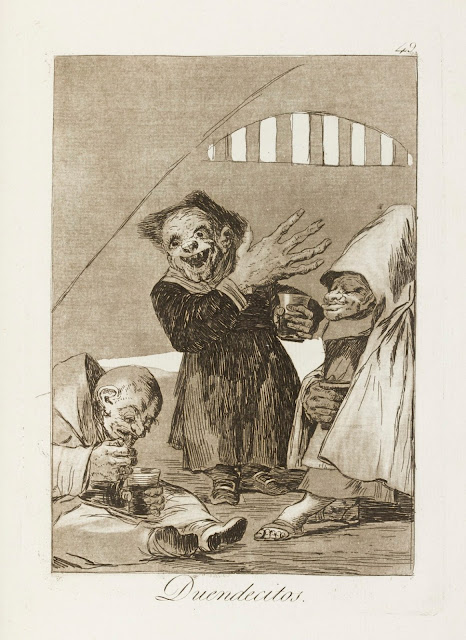
Duendecitos Source: Royal Academy of Arts Today, Francisco Goya is known as one of the most creative and forward-looking artists of the late eighteenth and early nineteenth centuries. This was a turbulent time in Europe, marked by war, revolution, and intellectual and political upheaval. This chaos provided ample artistic subjects for Goya, and current events and social attitudes became frequent themes in his work. Hobgoblins ( Duendecitos in Spanish) comes from Goya’s Caprichos , a series of prints created around the turn of the century. These prints present a satirical image of Spanish society, criticizing the follies, superstitions, and ignorance of people from every walk of life. The creation of the Caprichos marks a major turning point in Goya’s artistic life. Throughout his early career, Goya worked as a court artist, focusing mostly on formal portraits and tapestry cartoons intended to decorate royal residences. Since this work was created for patrons, it was fairly conventio...

Fear by Odilon Redon (Interpretation and Analysis)

Image
Fear Source: Art Institute of Chicago French painter Odilon Redon was the leader of his own particular artistic revolution. His work was far ahead of its time, so much so that his art would inspire and inform the work of Surrealist painters and other modern art movements years after Redon’s death. Redon was aligned with the Symbolist movement, which centered on the idea of seeking a higher truth through art. Unlike previous generations of artists who sought truth through realism, Symbolist artists reacted against the increasing industrialization and standardization of the modern world. Instead, they used their own powers of imagination, dreams, and visions to explore the artist’s personal experience of reality. Redon’s paintings and drawings are wildly creative and inventive, utilizing a unique and easily recognizable visual style. His early work is particularly innovative; as a young artist, Redon created a series of noirs , drawings and lithographs executed in shades of black. These ...

Pretty Teacher! (Linda maestra!) by Francisco Goya (Interpretation and Analysis)

Image
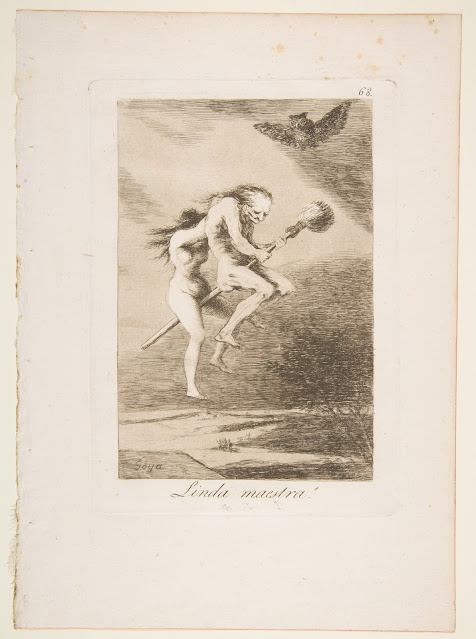
Linda maestra! Source: Metropolitan Museum of Art Francisco Goya can best be described as a visionary artist. Goya’s work was wildly original, and his art often touches upon strange and fantastical themes. He was certainly way ahead of his time compared to other eighteenth century Spanish artists. Goya’s print series Los Caprichos , published in 1799, is widely considered to be one the most influential artistic projects of its time. The Caprichos were not widely known at the time of their publication, but they had a resounding impact on art over the next hundred years. Although the Caprichos series explores themes of the Enlightenment—which is usually associated with logic and reason—many of the prints are incredibly dark, full of violence, chaos, and black magic. Thus, they’re perfect for Spooky Season (a.k.a. October). Two of the major themes in Los Caprichos are prostitution and witchcraft, both of which are closely related to the way Goya viewed social ills in contemporary Spani...

The Smiling Spider by Odilon Redon (Interpretation and Analysis)

Image
Smiling Spider Source: Wikimedia Commons French painter Odilon Redon was a revolutionary artist. Or, perhaps it’s better to say that he was the leader of his own particular artistic revolution. His work was far ahead of its time, so much so that his art would inspire and inform the work of Surrealist painters and other modern art movements years after Redon’s death. So, what makes his work so revolutionary? Redon’s paintings and drawings are wildly creative and inventive, utilizing a unique and easily recognizable visual style. His early work is particularly innovative; as a young artist, Redon created a series of noirs , drawings and lithographs executed in shades of black. These pieces tend to be dark, bizarre, and melancholic with otherworldly or supernatural themes. The Smiling Spider is one of Redon’s most famous noirs . As the title suggests, the piece is a lithograph of a grinning spider with a humanoid face. Its ten legs are sprawled across the page, making it seem almost like...

Arachne by Gustave Doré (Interpretation and Analysis)

Image
Arachne Source: indrasmusings.wordpress.com Literature is often a rich source of subject matter for artists. However, Dante’s Divine Comedy has inspired more than its fair share of art. I suppose envisioning a journey through Hell, Purgatory, and Heaven is really too full of creative possibilities to ignore! During the 1860s, French artist and illustrator Gustave Doré became part of this rich tradition when he decided to create a series of engravings to accompany Dante’s epic. Although Doré had trouble finding a publisher who was willing to take on the expense of printing such a long and heavily illustrated text, Doré’s illustrations have now become the quintessential images of Dante’s journey. Although Doré’s engravings of Hell are dramatic and disturbing, I think the most memorable and horrifying image comes from Purgatorio : the illustration of Arachne. In the twelfth canto of Purgatorio , Dante meets Arachne, a figure from Greek mythology. According to legend, Arachne was a we...

Absolutely the Best Paintings of Cats

Image
Cats occupy a very unique place in the story of art. For some reason or another, felines have been a source of inspiration for artists from all ages of history and from all corners of the world. However, not all pieces of cat art are created equal. Simply put, some pieces of art capture the spirit of the cat better than others.  Below, I’ve listed some of my favorite paintings of cats: pieces of art that—in my opinion— capture the various attitudes and personalities of the elegant and mysterious cat.  Cat, 1976 by Andy Warhol - Andy Warhol was a cat person. This is a fact that endears him to me tremendously. Throughout his career, he painted, drew, and photographed many cats. However, I think this particular piece is the perfect image of a modern cat. Here, we see a sleek Siamese cat with an angular face gazing off into the distance. Perhaps he is looking forward to the technological and scientific advances of the twentieth century, but it’s more likely that he’s watching a sp...

Baquiné Series by José R. Alicea (Interpretation and Analysis)

Image
There are few subjects in Puerto Rican art that carry more emotional and cultural significance than the baquiné . The baquiné is a traditional practice that has its roots in African cultures; the ceremony, which is essentially a wake, celebrates the child’s ascension to Heaven after his or her death and is underpinned by the belief that the dead infant is now an angel.  Baquiné II (El gran ciempiés) Source: Museo de Arte de Puerto Rico Naturally, this sad, yet poetic, subject inspired much creative and emotional outpouring. In fact, the baquiné is the subject of one of the most famous paintings in Puerto Rico’s history: Francisco Oller’s El Velorio .  Baquiné III (Zape, zape, zape) Source: Museo de Arte de Puerto Rico Which is why José Alicea’s Baquiné series is such an important group of paintings in the story of Puerto Rico. Alicea, who studied with the great Puerto Rican artist Miguel Pou, is best known today for his prints and woodcuts. This particular series of prints ...

A Jig Beyond the Grave (El Jarabe en Ultratumba) by José-Guadalupe Posada (Interpretation and Analysis)

Image
A Jig Beyond the Grave Source: Museum of Modern Art Today is the last day of Mexico’s famed Day of the Dead festival, and, to celebrate, I want to share a rather wonderful print by Mexican illustrator José-Guadalupe Posada. Although The Day of the Dead has only recently become well-known in American pop-culture (and is drastically misunderstood), it is in fact an ancient festival with roots in pre-Columbian Mesoamerican cultures. The iconography surrounding the festival is similarly well-established. However, there are few artists who have had a bigger impact on how we see the Day of the Dead than José-Guadalupe Posada. Posada was primarily an illustrator, creating over twenty thousand drawings and lithographs for pamphlets and books. However, he returned to one theme over and over again: calaveras . Calaveras are decorative skulls that are often used to celebrate the Day of the Dead. Posada included them in much of his work, using them as a means to express cultural and political cri...

Puss in Boots by Gustave Doré (Interpretation and Analysis)

Image
Puss in Boots Source: Wikipedia I’m told that today is National Cat Day, so I’d like to celebrate that with a particularly entertaining piece of cat art: Puss in Boots by Gustave Doré. Doré was a French artist who was best known for his illustrations of books and poems. He created this engraving of Puss in Boots to accompany the cat’s story in a book of fairy tales. The illustration depicts the character of Puss in Boots raising the alarm as another character drowns in the background; the original caption for the image read: "Help! The Marquis of Carabas is drowning." Although the engraving clearly displays Doré’s artistic skill (he was an acknowledged master of the woodcut-engraving technique), its true charm comes from Doré’s creative use of detail. The cat is resplendent in a pair of truly extraordinary boots, a necklace of bird’s heads, and a brace of dead mice hanging from his belt. The cat stands on two legs with an animated, almost human expression. Doré’s de...

The Witches by Hans Baldung (Interpretation and Analysis)

Image
The Witches Source: MET Museum The Halloween season is the perfect time of year to discuss witches, and, fortunately for us, many artists were fairly obsessed with witchcraft. This includes German artist Hans Baldung, who seemed to take particular pleasure in crafting the most outlandish and gratuitous supernatural scenes possible. Baldung was a student of the great Albrecht Dürer—one of the most famous and important artists in Western history—and he shared his master’s passion for printmaking. The Witches is a fine example of Baldung’s printmaking mastery. It uses the technique of chiaroscuro woodcut, which, according to my research , was a revolutionary development in printmaking that involved using different woodblocks inked with different colors to form an image. This allowed for greater depth and contrast in prints. Aside from the artistic innovations, I find this piece to be a really fun piece of art. It depicts a group of nude witches gathered around a caldron that seems to emi...

Knight, Death, and the Devil by Albrecht Dürer (Interpretation and Analysis)

Image
Knight, Death, and the Devil Source: MET Museum There are few individuals who have revolutionized art more than Albrecht Dürer. Dürer—a German printmaker and painter who worked during the fifteenth and sixteenth centuries—is known today for being one of the first artists to trademark and mass produce his work for sale to the public. Because of this, Dürer’s work achieved great popularity during his lifetime, which has continued to this day. One of his most famous prints is entitled Knight, Death, and the Devil . This spooky name makes it the perfect piece to include in my October art collection; however, the actual content of the print is a little more mundane. The piece depicts a knight on horseback, riding through a rocky gorge. Two horned figures, one representing the devil and one representing death on a pale horse, leer at the knight. Death carries an hourglass, a reminder that death comes for everyone, even the knight. According to my research , Dürer chose to craft the print as ...

Out Hunting for Teeth (A Caza de Dientes) by Fancisco Goya (Interpretation and Analysis)

Image
Out Hunting for Teeth Source: MET Museum Francisco Goya’s print series Los Caprichos is widely considered to be one the most influential artistic projects of its time. The Caprichos were not widely known at the time of their publication, but they had a resounding impact on art over the next hundred years. Although the Caprichos series explores themes of the Enlightenment—which is usually associated with logic and reason—many of the prints are incredibly dark, full of violence, chaos, and black magic. Thus, they’re perfect for Spooky Season (a.k.a. October). A Caza de Dientes (which translates to Out Hunting for Teeth ) is one of the most disturbing scenes in the series. The piece depicts a young woman reaching into the mouth of a hanged man to extract his teeth. Her face is turned away in horrified disgust and she holds a cloth up to her cheeks as if it will defend her from the repulsive act she performs. The corpse hangs from a rope of the right, hands bound together and feet bare...

Melencolia by Albrecht Dürer

Image
Melencolia Source: MET Museum German artist Albrecht Dürer was probably one of the most influential artists of the early modern age. Dürer was one of the first artists to take advantage of the printing press as a way to promote his work and himself as an artist. He did this in part by developing a unique signature, which survived as a kind of copyright mark, and he became one of the first artists to consistently sign his work. This branding allowed for widespread demand for his work, especially his prints. Dürer created a wide portfolio of prints (which mostly depicted religious scenes) that became household images that are now permanently ingrained in the collective psyche. One of Dürer’s most famous prints is entitled Melencolia , and I guarantee you’ve seen it before. It is one of the best-known pieces of art from the sixteenth century and is widely reproduced in textbooks and as wall art. Although the print is widely known, the meaning of the piece is hotly contested, and there...

Ni así la Distingue (Even Thus he Cannot Make her Out) by Francisco Goya (Interpretation and Analysis)

Image
Ni así la Distingue Source: Museo del Prado Spanish artist Francisco Goya is known as one of the leading artists of the Enlightenment period. The Enlightenment was an intellectual movement that developed in eighteenth century Europe; the movement encouraged people and governments to act in more logical and rational ways that were based on scientific study and observation of the natural world. Goya, as a member of the Enlightenment movement, was particularly bothered by superstition and backwards social customs more generally. In a series of prints entitled Los Caprichos, Goya set out to identify and criticize the many faults of Spanish society, which was mired in centuries-old superstitions, corruption, and outdated social customs at the time. Goya was particularly interested in exploring the relationships between men and women, which were disproportionately dominated by hypocrisy and exploitation at the time. A large number of the Los Caprichos prints focused on this theme. Ni a...

¡Qué sacrificio! (What a sacrifice!) by Francisco Goya (Interpretation and Analysis)

Image
¡Qué sacrificio! Source: Wikimedia Commons Francisco Goya’s print series Los Caprichos is widely considered to be one the most influential artistic projects of its time. Although the Caprichos were not widely known at the time of their publication, they had a resounding impact on art over the next hundred years. One of the major themes of the series is the relationship between men and women. ¡Qué sacrificio! is an excellent example of this theme. The piece depicts a young woman in a white dress surrounded by a crowd of leering men. One man, whom Goya portrays as an oafish lout, leans toward her, examining her in a suggestive way. The woman, whom Goya portrays as the victim of the situation, looks away from the men, pain and distress evident on her face. The piece implies that the man is courting her in some way, with the title suggesting that the woman will be forced to accept his advances. The print offers a criticism of the social structures that forced young women to bind the...

Nadie Se Conoce (Nobody Knows Himself) by Francisco Goya (Interpretation and Analysis)

Image
Nadie Se Conoce Source: The Metropolitan Museum of Art As I have written many times, Spanish artist Francisco Goya was one of the most forward looking and inspired artists of his time. His work was extraordinary in terms of style and content, and his impact on art is immeasurable. However, it is his Caprichos series that ranks as one of his most astonishing artistic accomplishments. Goya published Los Caprichos —a series of etchings that depict the social ills of contemporary Spanish culture, in 1799—at the dawn of a new century that would change Spain forever. Nadie Se Conoce (which translates to Nobody Knows Himself ) is the sixth print in the series. The piece contains multiple layers of meaning. On the surface, it is a carnival scene with disguised men and women cavorting in the streets. Traditionally, carnival was a time when people could let loose and disregard traditional social roles and limitations. Thus, the festival functions as a liminal space in culture, acting as a ...

Ya van Desplumados by Francisco Goya (Interpretation and Analysis)

Image
Ya van Desplumados Source: Wikimedia Commons I’ve written many times about my love for Francisco Goya’s work. Goya is one of my favorite artists. His work is endlessly interesting to me; his style is expressive and the content is often highly original and imaginative. One of the recurring themes in his oeuvre is the relationship between men and women. Goya was constantly interested in exploring human interactions and the way society treats certain individuals. Ya van Desplumados (which translates to There they go plucked) is an example of this aspect of his work. The print comes from the Los Caprichos series, a series of etchings that depict the social ills of contemporary Spanish culture. Ya van Desplumados depicts a group of prostitutes beating plucked birds with human heads with brooms. The birds represent the women’s clients. The implication is that they have “plucked” the men, stealing their money and possessions. Here, the women are portrayed as predators, preying on i...

Bolívar Marquez by José R. Alicea (Interpretation and Analysis)

Image
Bolívar Marquez Source: Flint Institute of Arts For the past two days, I’ve been discussing the art of conflict and how artists respond to war. I’m going to continue that today with a look at a different kind of conflict: political struggle. Art has long been a part of politics and political conflict. It is an excellent tool for spreading political messages and ideas; and history is dotted with political posters and paintings that changed hearts and minds. In the history of Puerto Rican art, political art tends to bend towards one cause: Puerto Rican independence and an end of colonialism. José Alicea clearly demonstrates this tendency in his print Bolívar Marquez . The print references a real historical event—the Ponce Massacre—however, Alicea’s print is more interested in conveying a political message than documenting the event itself. The Ponce Massacre occurred On Palm Sunday, March 21, 1937, when members of the Puerto Rican Nationalist Party and other civilians gathered in...

Collar y Cemí by José R. Alicea (Interpretation and Analysis)

Image
Collar y Cemí Source: The Museum of Modern Art When examining Puerto Rican art, you will find that the Taino people—Puerto Rico’s original inhabitants—are a recurring theme. Many Puerto Rican artists draw inspiration from the artifacts of Taino culture, taking advantage of their distinctive visual style to create bold and meaningful art. The idea that modern Puerto Ricans are connected to the Tainos—either genetically or culturally—is an important cornerstone of Puerto Rican identity and an underpinning concept in the Puerto Rican nationalist movement. Puerto Rican artist José Alicea explores this idea in his print Collar y Cemí . Alicea is one of many Puerto Rican artists who became interested in printmaking in the mid to late twentieth century. Today, he is well known for his prints and woodcuts and for his interest in portraying social and historical subjects. At first glance, Collar y Cemí appears to be a drawing of a Taino collar, a ritual item often uncovered at archeologi...

Look how Solemn they Are! (Miren que Grabes!) by Francisco Goya (Interpretation and Analysis)

Image
Look how Solemn they Are! Source: MET Museum Today, I want to return to one of my favorite topics in art, Francisco Goya’s groundbreaking series of prints: Los Caprichos . Goya published Los Caprichos —a series of etchings that depict the social ills of contemporary Spanish culture, in 1799—at the dawn of a new century that would change Spain forever. This print, entitled Miren que Grabes! (which translates to Look how Solemn they Are! ) is the sixty-third print in the series. It presents a criticism of Spain’s hereditary nobility. Here, we see two monstrous “witches,” which many contemporary accounts identify as representatives of the nobility and clergy, sitting astride two donkey-like animals. It is noted that, “[o]ne of them is a courageous thief. The other is a fanatic savage. Such are the kings and principal magistrates of the towns. Even with all of this... [the people] acclaim them and trust them with their government.” Goya mocks the false righteousness and dignity of a...