Posts

Showing posts with the label Northern Renaissance

Adoration of the Mystic Lamb by Hubert van Eyck and Jan van Eyck (Interpretation and Analysis)

Image
Adoration of the Mystic Lamb Source: Google Arts and Culture The Ghent Altarpiece  is probably one of the most famous and most valuable pieces of art in the world. This fifteenth-century polyptych contains twelve panels; the upper register depicts Christ flanked by the Virgin Mary, Saint John the Baptist, choirs of angels, and Adam and Eve. The bottom panels show a gathering of pilgrims and saints worshipping the Lamb of God. Over its long history, the altarpiece has become known as one of the “most stolen” pieces of art ever. According to my research , the altarpiece has been stolen or attacked at least four times. Most recently, The Ghent Altarpiece  was stolen by the Nazis during World War II. Fortunately, it was recovered in the famous Altaussee salt mine—a storehouse of stolen Nazi art—towards the end of the war. Today, the piece resides in a thirty million Euro, custom-built, climate-controlled case of bulletproof glass. One could write an entire book about Th...

The Census at Bethlehem by Pieter Bruegel the Elder (Interpretation and Analysis)

Image
The Census at Bethlehem Source: Wikimedia Commons As Christmas approaches, I decided to share some festive art to get everyone in the holiday spirit! Today, we’re going to take a look at The Census at Bethlehem by Pieter Bruegel the Elder, one of the greatest and most interesting painters in Western history. Bruegel is the quintessential Northern Renaissance artist. His style is unique and eclectic, reminiscent of the work of Hieronymus Bosch in its oddity. Today, Bruegel is known for his distinctive landscapes, scenes of everyday life, allegorical paintings, and his Northern Renaissance panache in general. The Northern Renaissance—a term I’m using pretty loosely here—refers to an artistic movement in northern Europe that occurred at roughly the same time as the Italian Renaissance. Art of the Northern Renaissance is characterized by increased attention to the accurate portrayal of three dimensional space and greater realism in the depiction of the human form. However, art of the Nort...

Young Knight in a Landscape by Vittore Carpaccio (Interpretation and Analysis)

Image
Young Knight in a Landscape  Source: Wikimedia Commons Today, I want to take a look at a painting that makes history. Young Knight in a Landscape is the first full-length portrait in Western history. The piece was created by Venetian artist Vittore Carpaccio, who worked in the style of the Italian Renaissance. Venetian art tended to be original and unusual among Italian art, forming a unique style. This being said, Carpaccio’s style was especially unusual. Aside from the unique nature of Young Knight in a Landscape , it is also rather old-fashioned, showing influence from Medieval and early Renaissance art. It also bears evidence of Northern Renaissance influence. Art of the Northern Renaissance tends to be elaborate and hugely detailed, full of miniature scenes within paintings. This can certainly be seen in Young Knight in a Landscape . Carpaccio uses symbolism and clever placement of details to convey a message about the knight’s virtue. A parchment in the corner of the paintin...

The Hunters in the Snow by Pieter Bruegel the Elder (Interpretation and Analysis)

Image
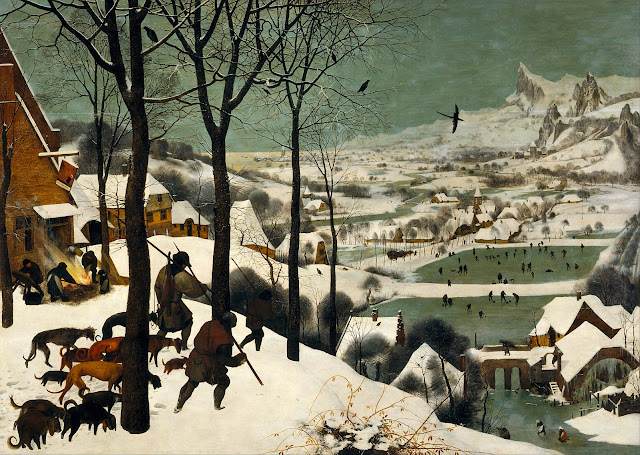
The Hunters in the Snow Source: Wikimedia Commons Pieter Bruegel the Elder is the quintessential Northern Renaissance artist. His style is unique and eclectic, reminiscent of the work of Hieronymus Bosch in its oddity. Today, Bruegel is known for his distinctive landscapes, scenes of everyday life, allegorical paintings, and his Northern Renaissance panache in general. The Hunters in the Snow is one of his most famous paintings. It depicts a small village awash in white, fluffy snow. In the foreground, a group of hunters return from their work accompanied by a pack of curly-tailed dogs. They walk downhill toward the village, where some of the townspeople are at work while others skate on the ice. In the background, craggy mountains loom over the scene. The painting is rich in detail, executed with loving and painstaking precision. On the surface, The Hunters in the Snow seems to be a straightforward, secular painting. However, taken in the context of Bruegel’s life, it is a wistful, ...

Rest on the Flight into Egypt by Joachim Patinir (Interpretation and Analysis)

Image
Rest on the Flight into Egypt Source: Museo del Prado Now that we’re in December, Christmas is drawing closer. So, in honor of the approaching holiday, I want to share a painting by the Northern Renaissance master Joachim Patinir. Like many painters of his time, Patinir focused on religious subjects. One of his religous paintings is Rest on the Flight into Egypt , an oft depicted motif in Christian. The piece depicts a scene from the gospel of Matthew in which an angel appears to Joseph in a dream to warn him that Herod is seeking to kill the Christ child. Upon waking, Joseph took Mary and Jesus and fled to Egypt, where the family was safe. Although the rest on this journey is not specifically mentioned in the bible, it became a part of recognized Christian iconography by the fourteenth century, and, over the years, it has provided the framework for some of the most imaginative pieces of art in Western history. Patinir’s Rest on the Flight into Egypt takes a particularly creative appro...

The Ambassadors by Hans Holbein the Younger (Interpretation and Analysis)

Image
The Ambassadors Source: Wikimedia Commons Today, Hans Holbein the Younger is primarily known as one of the greatest portrait artists of the sixteenth century. He is particularly famous for a rather striking painting of King Henry VIII. However, today I’m going to be talking about Holbein’s spookiest masterpiece: The Ambassadors . At first glance, The Ambassadors is a straightforward portrait of two french diplomats named Jean de Dinteville and Georges de Selve. The two men probably commissioned the painting while working in London, as Holbein spent a considerable portion of his career working in England. The painting depicts the two men standing in a richly appointed room. Between them, a table holds musical instruments, scientific tools, and books. One of the ambassadors was a member of the clergy, while the other was a landowner. These items represent the secular and sacred knowledge that the two men possess. The items could symbolize the way these two types of knowledge complement ...

The Witches by Hans Baldung (Interpretation and Analysis)

Image
The Witches Source: MET Museum The Halloween season is the perfect time of year to discuss witches, and, fortunately for us, many artists were fairly obsessed with witchcraft. This includes German artist Hans Baldung, who seemed to take particular pleasure in crafting the most outlandish and gratuitous supernatural scenes possible. Baldung was a student of the great Albrecht Dürer—one of the most famous and important artists in Western history—and he shared his master’s passion for printmaking. The Witches is a fine example of Baldung’s printmaking mastery. It uses the technique of chiaroscuro woodcut, which, according to my research , was a revolutionary development in printmaking that involved using different woodblocks inked with different colors to form an image. This allowed for greater depth and contrast in prints. Aside from the artistic innovations, I find this piece to be a really fun piece of art. It depicts a group of nude witches gathered around a caldron that seems to emi...

The Fall of the Rebel Angels by Pieter Bruegel the Elder (Interpretation and Analysis)

Image
The Fall of the Rebel Angels Source: Wikimedia Commons Pieter Bruegel the Elder is the quintessential Northern Renaissance artist. His style is unique and eclectic, reminiscent of the work of Hieronymus Bosch in its oddity. Today, Bruegel is known for his distinctive landscapes, scenes of everyday life, allegorical paintings, and his Northern Renaissance panache in general. The Northern Renaissance (a term I’m using pretty loosely here) refers to an artistic movement in northern Europe that occurred at roughly the same time as the Italian Renaissance. Art of the Northern Renaissance is characterized by increased attention to the accurate portrayal of three dimensional space and greater realism in the depiction of the human form. However, art of the Northern Renaissance lacks the grandiose style of its Italian counterparts; instead, northern artists focused on more down-to-Earth scenes of everyday life and religious subjects. One such religious painting is Bruegel’s The Fall of the ...

Ship of Fools by Hieronymus Bosch (Interpretation and Analysis)

Image
Ship of Fools Source: Wikimedia Commons Among the art of the Northern Renaissance period, there are perhaps no stranger or more imaginative paintings than the work of Hieronymus Bosch. Bosch is probably most famous for his religious paintings ( The Garden of Earthly Delights is certainly his most well known work), but he also executed several secular paintings during his lifetime. These works contained social commentary, references to daily life, and sometimes even criticism of social institutions. Ship of Fools is one such painting. The painting makes reference to a common trope in Western thought. The idea of the ship of fools was conceived by Plato, who used it to describe the problems of a political system that was not directed by persons of experience. However, in later years, the ship of fools became a common metaphor for all kinds of social ills and vices. The trope could also be used as a screen for veiled criticisms of social institutions, such as religion and government...

Saint Barbara by Robert Campin (Interpretation and Analysis)

Image
Saint Barbara Source: Museo del Prado The art of the Northern Renaissance holds a special place in my heart. The Northern Renaissance (a term I’m using pretty loosely here) refers to an artistic movement in northern Europe that occurred at roughly the same time as the Italian Renaissance. Art of the Northern Renaissance is characterized by increased attention to the accurate portrayal of three dimensional space and greater realism in the depiction of the human form. However, art of the Northern Renaissance lacks the grandiose style of its Italian counterparts; instead, northern artists focused on more down-to-Earth scenes of everyday life and religious subjects. Robert Campin is one such artist. Although he is primarily a painter of religious scenes, Campin’s art is very much grounded in everyday life. His painting of Saint Barbara—one third of a lost triptych—is a good example of his style. Here we see the saint—not yet crowned by a golden halo—reading a book in front of a fire, j...

Triptych of the Temptation of Saint Anthony by Hieronymus Bosch (Interpretation and Analysis)

Image
Triptych of the Temptation of Saint Anthony Source: Wikimedia Commons I don’t know how I’ve managed to write this blog for four months without mentioning the work of one of the strangest painters of all time, Hieronymus Bosch. Bosch was active during the period of the Northern Renaissance, although, in my opinion his work owes a lot to the Medieval period. Although I wouldn’t say Bosch is one of my favorite painters, I do find his work to be endlessly interesting and entertaining. This is mostly because it’s just so strange ! Bosch’s work is highly imaginative, and his style is instantly recognizable (although that can sometimes lead you astray, as many artists tried to replicate his style). In case you’re wondering what I mean by “highly imaginative,” I want to draw your attention to the man and woman riding on the back of a fish that is flying through the air at the top of the right panel (and, I should note that I’m using this example because some of the things in this tr...

Seven Sacraments Altarpiece by Rogier van der Weyden (Interpretation and Analysis)

Image
Seven Sacraments Altarpiece Source: Wikipedia The art of the Northern Renaissance holds a special place in my heart. The Northern Renaissance (a term I’m using pretty loosely here) refers to an artistic movement in northern Europe that occurred at roughly the same time as the Italian Renaissance. Art of the Northern Renaissance is characterized by increased attention to the accurate portrayal of three dimensional space and greater realism in the depiction of the human form. However, art of the Northern Renaissance lacks the grandiose style of its Italian counterparts; instead, northern artists focused on more down-to-Earth scenes of everyday life and religious subjects. Rogier van der Weyden was one such northern artist; van der Weyden—whose work dates to the early fifteenth century—was among the first wave of Northern Renaissance artists, and his Seven Sacraments Altarpiece is a good example of the style. Painted altarpieces were especially popular between the thirteenth and si...