Posts

Showing posts with the label Paul Gauguin

My Favorite Paintings of the Year

Image
2020 is over! I’m sure we’re all rejoicing that this difficult year is over. However, despite all the problems that 2020 created, I also had a great time exploring art over the past year. I’ve discussed 365 pieces of art in the past 365 days, so, today, I want to recap the year by talking about some of my favorite paintings that I’ve covered in the past year. Without further ado, let’s dive in. Happy New Year! 1. El Velorio by Francisco Oller - I can clearly remember the first time I saw Francisco Oller’s masterpiece El Velorio . A print of the famous piece was hanging on the wall of a Puerto Rican funeral home that I visited after the death of a relative. My mother identified the painting in passing, telling me that it was very famous. I later researched the painting on my own, and it has been one of my favorites ever since. El Velorio is one of the most famous pieces of art in Puerto Rico. Measuring eight by thirteen feet, El Velorio (which literally translates to The Wake) is tru...

Some Paintings to Celebrate Christmas

Image
Merry Christmas and Happy Holidays to all who celebrate! In honor of the holiday, I’ve decided to put together a collection of Christmas paintings to celebrate. Christmas Eve, 1887 by John Everett Millais - I think that most of us can imagine a Christmas scene. For obvious reasons, the holiday tends to be associated with Christmas trees, bells, and holly sprigs. Pre-Raphaelite artist John Everett Millais, however, took a different approach to the subject. The painting depicts a rural landscape, featuring crows and barren trees. Tiny footprints track through the snow and a brick manor house stands in the background. While it is a seemingly mundane scene, it is powerful and meaningful in its simplicity.  Christmas Eve, 1887 Source: Wikimedia Commons Christmas in the Brothel by Edvard Munch - Edvard Munch is well known as an eccentric, original painter. Munch is best known as the painter of The Scream , one of the most recognizable paintings in the world. His style is extremely dis...

Baby (Nativity Of Tahitian Christ) by Paul Gauguin (Interpretation and Analysis)

Image
Baby (Nativity Of Tahitian Christ) Source: WikiArt Paul Gauguin can best be described as a controversial—yet brilliant—artist. While Gauguin was a deeply unpleasant human being (for many reasons), he was also one of the most original and inventive artists of his age. Today, his paintings and sculptures are recognized for their original and expressive character and for Gauguin’s unique approach to color. Gauguin’s work is also remarkable for the mix of cultural themes and ideas that permeate his work. Gauguin is most famous for the art he executed while living in Tahiti, and, while his understanding of Tahitian culture was limited, his time in French Polynesia made a huge impact on his work. Bé bé ( Baby or Nativity Of Tahitian Christ ) is a fine example of the way Gauguin used cultural synchronism to create interesting and impactful art. As the title suggests, the painting is a variation on the traditional Christian nativity scene. Instead of a manger in Bethlehem with shepherds look...

Te Tamari no Atua (The Child of God) by Paul Gauguin (Interpretation and Analysis)

Image
Te Tamari no Atua Source: Wikimedia Commons The art of Paul Gauguin is endlessly interesting to me. Although Gauguin himself was a rather problematic individual, his art is extraordinary. To this day, his paintings and sculptures are recognized for their original and expressive character and for Gauguin’s unique approach to color. Gauguin’s work is also remarkable for the mix of cultural themes and ideas that permeate his work. Gauguin is most famous for the art he executed while living in Tahiti, and, while his understanding of Tahitian culture was limited, his time in French Polynesia made a huge impact on his work. Te Tamari no Atua (which roughly translates to The Child of God ) is a fine example of the way Gauguin used cultural synchronism to create interesting and impactful art. As the title suggests, the painting depicts Gauguin’s version of the Christian Nativity. Here, he reworks the birth of Christ as a Tahitian scene. In the foreground, a young woman—the mother—lies ...

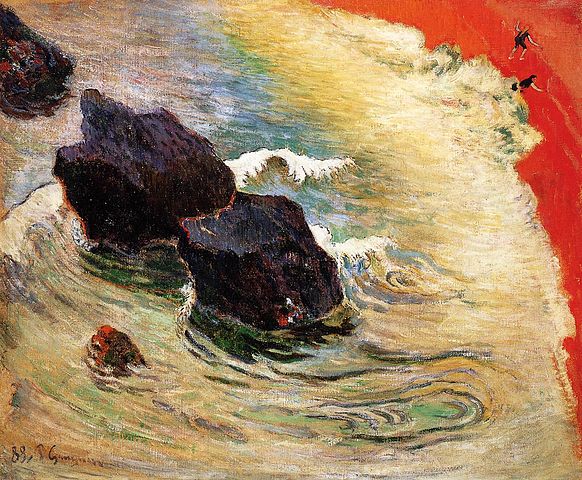
La Vague (Wave) by Paul Gauguin (Interpretation and Analysis)

Image
La Vague Source: Wikimedia Commons French artist Paul Gauguin is best known for his so-called Tahitian paintings, produced during his trips to Martinique, Tahiti, and the Marquesas Islands. However, he also produced many fine works of art while living in France. Gauguin was especially inspired by the region of Brittany, which he believed had a “savage, primitive quality.” La Vague (which translates to The Wave ) was painted during one of his trips to Brittany. According to my research , the painting represents the beginning of a major shift in Gauguin’s work, as he began to pursue a less realistic, more symbolic approach to art. In this piece, Gauguin challenges many elements of conventional Western art. The first unusual element of La Vague is the perspective. The piece is painted from a bird’s eye perspective, giving an unusual sense of proportion and scale (in point of fact, Gauguin actually sketched the scene from a bluff that overlooked the beach). The fact that there is no ...

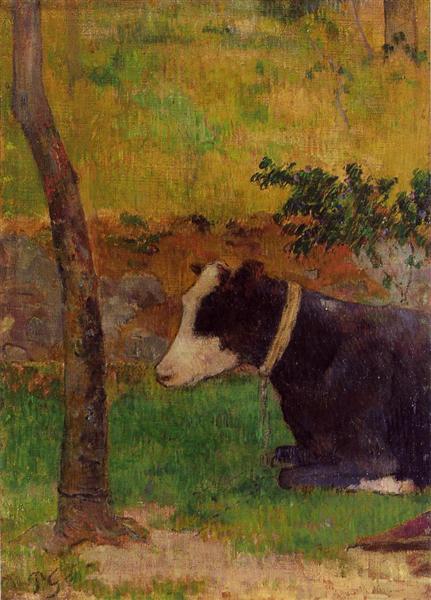
Kneeling Cow by Paul Gauguin (Interpretation and Analysis)

Image
Kneeling Cow Source: Wiki Art French artist Paul Gauguin is best known for his so-called Tahitian paintings, produced during his trips to Martinique, Tahiti, and the Marquesas Islands. However, he also produced many fine works of art while living in his home country, France. Kneeling Cow was painted during his first return to France after visiting the Caribbean island of Martinique. As the title suggests, the painting depicts a kneeling black and white cow on a background of yellow and green. Gauguin often explored landscapes and nature imagery in his art, using it as a tool to explore other themes and to play with color and composition. Gauguin was particularly interested in portraying the countryside of Brittany, and made many paintings and drawings in the pastoral style. Although Kneeling Cow is by no means one of Gauguin’s major works, it is a snapshot of his artistic style and a fine example of his Breton work. Personally, I also find it to be a rather charming and sweet pai...

When will you Marry? by Paul Gauguin (Interpretation and Analysis)

Image
When will you Marry? Source: Wikimedia Commons Though Paul Gauguin is a rather controversial figure in the art world, it is undeniable that his paintings are among the finest ever produced by a Western artist. Gauguin had a great genius for expressing emotional and psychological truths through art, relying on a complex and colorful visual language to achieve this effect.  At its core, Gauguin’s art seeks to access a level of authenticity in each painting, with Gauguin seeking to explore the essence of each subject he painted. His most famous paintings date from his time in Tahiti, which Gauguin traveled to in hopes of finding a more genuine way of life, separate from the industrialized towns and cities of Europe. When will you Marry?  is one of Gauguin’s most famous paintings from his Tahitian period, and it became one of the most expensive paintings ever sold when it was purchased by a private collector for three hundred million dollars in 2015. The painting portrays tw...

Merahi metua no Tehamana (Tehamana Has Many Parents or The Ancestors of Tehamana) by Paul Gauguin

Image
Merahi metua no Tehamana Source: Wikimedia Commons As a human being, Paul Gauguin is somewhat infamous in the art world. The nineteenth century French painter has been connected to many racist and misogynist acts, and his work has been tied to ideas of colonialism by modern scholars. However, his artistic skill is beyond compare, and I really do enjoy his painting, so today I’m going to be talking about one of his masterpieces: Merahi metua no Tehamana . The title, which roughly translates to Tehamana Has Many Parents or The Ancestors of Tehamana , refers to Gauguin’s Tahitian lover Tehamana (their relationship is quite problematic because she was a young teenager at the time, but we’ll set that aside for now and just talk about the painting). The painting depicts Tehamana in a European style of dress as she stands in front of a painted fresco that seemingly portrays Tehamana’s ancestors. Gauguin was interested in all varieties of spiritual and religious experience, and this paint...

Vision After the Sermon by Paul Gauguin (Interpretation and Analysis)

Image
Vision After the Sermon Source: National Galleries Scotland It’s been a while since I’ve talked about a painting by Paul Gauguin (a terrible person, yet a wonderful artist), so today I want to touch on one of his earlier pieces: Vision After the Sermon . As I noted, Vision After the Sermon was one Gauguin’s earlier works, completed before he left France for Tahiti. Although his most famous pieces were based on his experiences in the Pacific, Gauguin established the basis of his artistic ethos in France. Vision After the Sermon depicts a group of Breton women, looking on with prayerful expressions as an angel wrestles a man under a tree. The painting references the biblical story of Jacob wrestling an angel. As art historian Zuzanna Stanska explains , the piece suggests, “that the faith of these pious women enabled them to see miraculous events of the past.” Gauguin himself explained: “For me, the landscape and wrestling match in this picture exist only in the minds of the peopl...

La Orana Maria by Paul Gauguin (Interpretation and Analysis)

Image
La Orana Maria Source: Metropolitan Museum of Art Today, I want to talk about my favorite Gauguin painting: La Orana Maria (Hail Mary). In this piece, Gauguin reimagines traditional European imaginary of the Madonna and Child. Here, a Tahitian woman represents the Virgin Mary and a toddler perched on her shoulder represents the Christ Child. Gauguin described it as “an angel with yellow wings reveals Mary and Jesus, both Tahitians, to two Tahitian women, nudes dressed in pareus, a sort of cotton cloth printed with flowers that can be draped from the waist. Very somber, mountainous background and flowering trees . . . a dark violet path and an emerald green foreground, with bananas on the left. I'm rather happy with it." To my knowledge, Gauguin was not a particularly religious person, but he was certainly interested in spiritual experience, as can be seen in his famous painting Vision after the Sermon. La Orana Maria continues in this vein, using the contrast of the ...

Spirit of the Dead Watching by Paul Gauguin (Interpretation and Analysis)

Image
Spirit of the Dead Watching Source: Wikipedia Today, I want to turn my attention back to the work of Paul Gauguin to talk about his painting Spirit of the Dead Watching . There are a lot of different interpretations of this work, as you’ll find if you Google it. Many people interpret this painting through the lens of colonialism, racism, and sexism. I think those interpretations are important and valid, and there’s some good information about them here . However, today I’m going to talk about the way that I read the painting. As I’ve said before, Gauguin was clearly inspired by the Romantic movement, especially its emphasis on the emotional and spiritual life The Nightmare Source: Wikipedia of the individual. By the time Gauguin was active as an artist, the idea of psychoanalysis — developed by the famous Sigmund Freud — was emerging into mainstream thought. In my opinion, the figure in the background (the so-called “Spirit of the Dead”) is a representation o...

Day of the God by Paul Gauguin (Interpretation and Analysis)

Image
Day of the God Source: Art Institute of Chicago Today, I want to revisit the work of Paul Gauguin. As I explained yesterday, Gauguin was a Post-Impressionist French painter who was inspired by Romanticism. His most famous work comes from his trips to Tahiti, including the painting we’re talking about today: Day of the God . Like Where Do We Come From? What Are We? Where Are We Going? , Day of the God is an allegorical painting. According to The Art Institute of Chicago, the three figures in the middle ground represent birth, life, and death, while the water in the foreground represents life itself. In the background, Tahitians perform a ritual near a sculptured figure that seems to represent what is beyond these three stages: the metaphysical realm. I read the painting as a psychological landscape. Here, Gauguin portrays spiritual reality. The piece is an attempt to use art to access a higher state of being. Aside from the symbolism, Gauguin’s use of color in Day of the God ...

Where Do We Come From? What Are We? Where Are We Going? by Paul Gauguin (Interpretation and Analysis)

Image
Where Do We Come From? What Are We? Where Are We Going? Source: Museum of Fine Arts Boston Paul Gauguin was a racist, misogynist, extremely ethnocentric, and, all around, a terrible person. However, he was one of the most talented artists of his time, and I really do love his work. If you want to read more about why Gauguin is problematic, I wrote about it here. Although Gauguin is not considered an artist of the Romantic movement, his work certainly embodies many of the ideas of Romanticism. Romanticism was the “back to nature” movement of its time. It was a reaction against industrialization and the idea that everything in the world could be explained by science and rational thought. Instead, Romantics sought to find meaning in nature and in spiritual experiences. Gauguin was also one of the many Europeans in the 19th and early 20th centuries who became fascinated with the idea of the exotic. This craze can best be compared with the prevalence and problems of cultural appro...