Posts

Showing posts with the label Leonora Carrington

The Ancestor by Leonora Carrington (Interpretation and Analysis)
Image
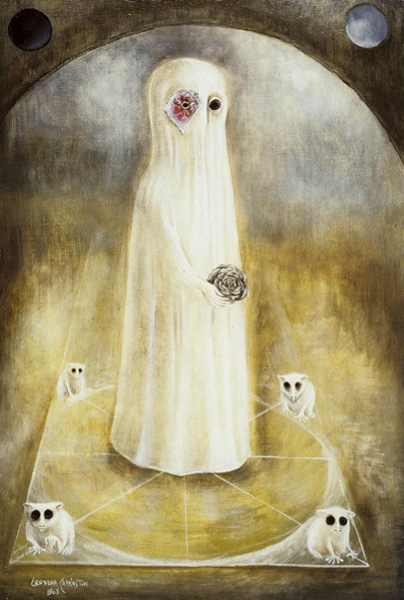
The Ancestor Source: Museo de Mujeres Leonora Carrington occupies a unique place in art history. Forced to flee Europe during World War II, Carrington spent most of her adult life in Mexico, where she found an artistic home. A member of the Surrealist movement, Carrington’s art was extraordinarily creative and original as well as notoriously difficult to interpret. Carrington was a visionary, both literally and figuratively. She reported that she often had visions of ghosts and animals when she was a child; these memories undoubtably impacted her adult work. As well as being a visual artist, Carrington was also a writer, and her art often illustrated or referred to the fantastical concepts that emerged from her writing. Her history with ghosts might come into play in her 1968 painting The Ancestor . The painting depicts a spectral figure dressed in a sheet and standing in the midst of a white circle. Around the edge of the circle, strange, ghostly animals gaze out at the viewer with ...

An Aardvark Groomed by Widows by Leonora Carrington (Interpretation and Analysis)

Image
An Aardvark Groomed by Widows Source: Biblioklept October is the season of Halloween and all things spooky, including witches. Witches are a common theme in Western art, but their depiction has changed over time. To my mind, Leonora Carrington’s An Aardvark Groomed by Widows offers a modern interpretation of the theme of witchcraft in art (even though the piece has ostensibly nothing to do with witches at all). The piece depicts a group of women dressed in black who are circled around a white aardvark in a bowl of water. As the title suggests, the women are washing and tending to the aardvark, who seems to be enjoying the attention. A faceless figure on the far left holds what seems to be a baby aardvark in its hands while a tiny figure in black sweeps the ground in the foreground of the painting. The background is an abstract wash of brown dotted with shadowy, indistinct animals and figures. Ritual is a major theme in Carrington’s work, and it’s clear that the women in An Aardvark Gr...

My Favorite Paintings of the Year

Image
2020 is over! I’m sure we’re all rejoicing that this difficult year is over. However, despite all the problems that 2020 created, I also had a great time exploring art over the past year. I’ve discussed 365 pieces of art in the past 365 days, so, today, I want to recap the year by talking about some of my favorite paintings that I’ve covered in the past year. Without further ado, let’s dive in. Happy New Year! 1. El Velorio by Francisco Oller - I can clearly remember the first time I saw Francisco Oller’s masterpiece El Velorio . A print of the famous piece was hanging on the wall of a Puerto Rican funeral home that I visited after the death of a relative. My mother identified the painting in passing, telling me that it was very famous. I later researched the painting on my own, and it has been one of my favorites ever since. El Velorio is one of the most famous pieces of art in Puerto Rico. Measuring eight by thirteen feet, El Velorio (which literally translates to The Wake) is tru...

Even More Crazy Self-Portraits

Image
A few weeks ago, I wrote a blog post entitled The Craziest Self-Portraits of all Time , in which I described some of the more unusual self-portraits I have encountered during my studies of art. I had a lot of fun with that post, so, today, I want to share a few more crazy self-portraits. Let’s dive in! Pumpkinhead Self Portrait by Jamie Wyeth - Jamie Wyeth is a member of the famous Wyeth family, and is the son and grandson respectively of celebrated painters Andrew Wyeth and N.C. Wyeth. Although he’s probably not as well known as his relatives, he’s certainly a famous and talented painter in his own right. One of his most famous and strangest paintings is his Pumpkinhead Self Portrait . In this painting, Wyeth removes himself from his own self portrait, a somewhat self deprecating gesture that invites the viewer to examine the work as a painting, not as an image of its creator. Alternatively, it might just be that the Wyeth family like Halloween. According to my research, “the Wyeths ...

Five Female Surrealists You Should Know

Image
When you hear the word Surrealism, you probably picture Salvador Dalí and his melting clocks or René Magritte and his pipe. However—although most of the most famous Surrealists were men—there is a rich history of female Surrealists that is often ignored by art education. Surrealist art seeks to bring the invisible things in life— thoughts, ideas, the human psyche— to the surface, expressing the spiritual and emotional worlds. So, today, I want to bring attention to some of my favorite female Surrealists and the weird and wonderful worlds they created through their painting. Bridget Bate Tichenor - Bridget Bate Tichenor came to art late in life. She spent most of her adult life as a model, fashion editor, and socialite in Paris and New York City. However, in the1950s she abandoned this life in order to seek spiritual fulfillment in Mexico, where she spent the rest of her life. While living there, Bate Tichenor began to create Surrealist paintings. She produced an oeuvre of fantastical ...

The Magical World of the Maya by Leonora Carrington (Interpretation and Analysis)

Image
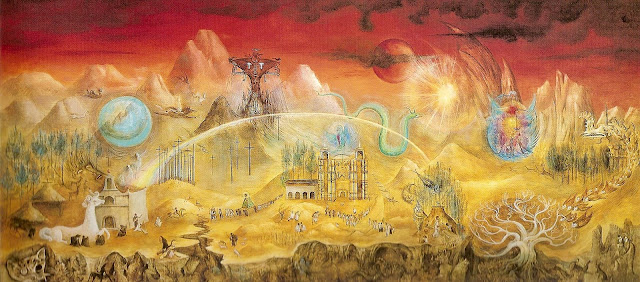
The Magical World of the Maya Source: Imgur I recently read a novel entitled Gods of Jade and Shadow , which tells the story of a young woman from Mexico who meets a Mayan death god and is forced to embark upon a quest with him. I enjoyed the novel tremendously, but while I was reading it, I was continually reminded of a painting that I encountered while researching Surrealist art in Mexico. The Magical World of the Maya was created by British-Mexican artist Leonora Carrington, a Surrealist artist who made her permanent home in Mexico after fleeing Europe during World War II. The painting—really a small mural—depicts some of the beliefs and stories of the Mayan people, both past and present. The painting is divided into three sections, the underworld, the world of humans, and the cosmic world of the gods. According to a publication about the mural published by the National Autonomous University of Mexico , the painting represents the relationship the Mayans experienced with their divi...

And Then We Saw the Daughter of the Minotaur! by Leonora Carrington (Interpretation and Analysis)

Image
And Then We Saw the Daughter of the Minotaur! Source: New York Times Although many art historians will tell you that the Surrealist movement began in Europe, it was truly nurtured in the central Americas. As World War II loomed over Europe, many Surrealist painters fled to Mexico, where great painters like Frida Kahlo were already exploring Surrealist themes and ideas. These artists formed a vibrant community and thrived on Mexico’s dynamic art scene. The rich history of central American visual arts made Mexico an even more appealing home for European expat painters. Surrealist painter Andre Breton described the appeal of Mexico to Surrealist artists in the following words : “Mexico, half-awake of its mythological past keeps evolving under the protection of Xochipilli, God of the flowers and lyric poetry, and Coatlicue, Goddess of the Earth and of the violent death (…) This power of conciliation of life and death is without a doubt the principal attractive that Mexico offers. ...